


Recruiting for medical sales is not like hiring for any other sales role. You are looking for a specific professional—someone who combines sales acumen with specialized clinical knowledge and existing relationships with healthcare providers.
This field requires individuals who can navigate the complexities of the medical device or pharmaceutical industries, understand regulatory compliance, and manage the long sales cycles common in hospitals and clinics. The primary goal is to find talent who can integrate quickly and generate revenue by leveraging their experience and network.
Why Your Medical Sales Recruitment Strategy Is Outdated

If you rely on conventional hiring methods for medical sales talent, you are likely falling behind. Posting on generic job boards or using slow, expensive recruiters often fills your pipeline with unqualified candidates and contributes to missed revenue targets. In a market this competitive, speed and precision are critical.
The primary issue is that top-performing independent reps—those with established surgeon relationships and a proven track record—are not actively searching job ads. They are passive candidates. They respond only to direct, relevant opportunities that align with the products they already carry. This is precisely where traditional recruitment tactics fail.
The New Market Reality
The global medical recruitment market is expanding significantly. It was projected to grow at a compound annual growth rate (CAGR) of 6.0% from 2024 to 2033. This growth is driven by a worldwide shortage of healthcare professionals, including the specialized sales representatives required to bring innovative devices to clinicians.
For device manufacturers, this new reality creates several challenges:
- Talent is Scarce: Reps with deep clinical knowledge in a specific niche are in high demand and difficult to find.
- Speed is Critical: An empty territory represents immediate lost revenue. When the hiring process extends beyond 30 days, top candidates often lose interest and accept other offers.
- Incentives are Misaligned: Many traditional recruiters are not structured to find commission-only (1099) representatives, who are often the most motivated and cost-effective hires for a growing company.
The most effective recruitment strategy is no longer about posting a job and waiting for applicants. It is about proactively sourcing talent by finding reps who are already active in your target hospitals and possess the necessary clinical expertise.
Adopting a Modern Framework
To succeed in this market, you need a modern approach built on precision, speed, and alignment. Stop casting a wide net and start targeting specific talent pools. Specialized platforms where verified, industry-specific reps actively seek new product lines are the solution.
By shifting your focus to marketplaces that pre-vet candidates and allow for direct connection, you can significantly shorten your hiring cycle. For a deeper analysis of process improvement, review our guide on how to hire sales reps. This strategy not only fills territories faster but also ensures a higher quality of representative, leading to a quicker ramp-up time and a stronger return on investment.
Build Your Ideal Medical Sales Rep Profile

Before posting a job or contacting a recruiter, you must define exactly who you are looking for. This is the most critical step in the process. Skipping it will result in wasted hours sifting through resumes from unsuitable candidates.
Create an "Ideal Representative Profile"—a detailed blueprint of the perfect candidate. This document is not a job description; it is a strategic tool that guides every sourcing and screening decision. You must be specific, detailing the exact skills and relationships that will enable success with your product in your target market.
Define the Non-Negotiable Skills
List the absolute must-have skills a representative needs to be effective from day one. Focus on the specific clinical and commercial experience that separates top performers from the rest.
Here is what to focus on:
- Clinical Environment Acumen: Where will this person operate? Do they need to be comfortable in a high-stakes operating room (OR), a cath lab, or a private physician's office? Be precise—an OR-focused representative has a different skill set than one who calls on clinic managers.
- Procedural Expertise: What specific medical procedures utilize your device? A rep who has supported complex spinal fusions brings a different network than one who has sold capital equipment to hospital procurement.
- Existing Relationships: Who must they already know? Is it orthopedic surgeons, interventional cardiologists, or members of the value analysis committee? In this industry, relationships are paramount.
- Sales Cycle Mastery: Does your product have a long, complex sales process involving hospital committees, or is it a quicker, transactional sale? Ensure the candidate's experience matches the reality of your sales cycle.
A sharp, detailed profile is your most powerful filter. It ensures you only spend time on candidates who can integrate your product into their existing routine and start generating revenue immediately.
Use this framework to ensure you cover all critical bases when defining your ideal candidate.
| Attribute Category | Key Questions to Answer | Example (Orthopedic Device) |
|---|---|---|
| Clinical Expertise | In which specific clinical settings do they need to be fluent (e.g., OR, ICU)? | Must have 3+ years of direct OR experience supporting orthopedic surgeries. |
| Procedural Knowledge | What specific surgical or medical procedures must they know inside and out? | Deep familiarity with total knee and hip arthroplasty procedures. |
| Physician Relationships | Which physician specialties must be in their existing network? | Established relationships with at least 10-15 orthopedic surgeons in the target territory. |
| Sales Experience | What kind of sales cycle have they managed (e.g., transactional, capital)? | Proven success selling "physician preference" items against established competitors. |
| Technical Acumen | How technically complex is your product? What level of understanding is required? | Able to discuss biomechanics and implant materials confidently with surgeons. |
| Geography & Call Points | What is the specific territory? Are there key hospital systems they must have access to? | Territory: Northern California. Must have access to decision-makers at Sutter Health and Kaiser Permanente. |
This table forces you to define concrete, measurable attributes. With this level of clarity, finding the right person becomes significantly easier.
Map the Territory and the Opportunity
Geography is more than a location; it is about understanding where talent pools and market opportunities converge. Medtech talent is often concentrated in specific hubs like Minneapolis-St. Paul and Southern California. Targeting reps already embedded in these ecosystems is a practical strategy.
Once the territory is defined, articulate why a top-performing medical device sales rep should consider adding your product to their portfolio. These professionals are busy and successful; present a compelling business case. Be clear about your commission structure, the untapped market potential in their area, and the clinical and marketing support you will provide.
Clarity on these points is non-negotiable. It is what separates your opportunity from others and attracts the A-players you need.
Find Talent Where Top Reps Are Actively Looking
To hire the best, you must move beyond passively posting on generic job boards. The top independent reps—those with strong surgeon relationships and a full sales portfolio—are not browsing job sites. They are passive candidates who only engage with highly relevant opportunities.
This requires a smarter, more targeted sourcing strategy. You must go where the talent is, as relying on outdated methods will lead to a slow, frustrating, and expensive search.
Comparing Your Sourcing Options
Let's break down the main channels for finding these representatives. Each has trade-offs in terms of speed, cost, and candidate quality.
-
Traditional Recruiters: These firms can be effective for W-2 hires but often misunderstand the commission-only (1099) model. Their fee structure—typically 20-30% of a first-year salary—is not well-suited for a commission-based role. Furthermore, the process is often slow as they act as an intermediary.
-
Professional Networks (like LinkedIn): LinkedIn is a useful tool for initial research but is a crowded platform. Your message is one of many in a top rep's inbox, and it is difficult to verify their real-world call points and product lines without significant research.
-
Specialized Marketplaces: Platforms like Zilla Sales are designed to connect medical device companies with pre-vetted, independent sales reps who are actively seeking new products. This allows you to bypass the noise and connect directly with qualified individuals who have the relationships you need.
The primary bottleneck in recruitment is not a lack of talent but an efficiency problem. Your goal should be to spend less time sifting through unqualified leads and more time engaging with reps who can start selling your product immediately. A specialized marketplace addresses this issue.
Why Agile Platforms Win
The medical device market moves too quickly for slow, outdated hiring processes. The growth in this sector demands reps who are not only connected but also comfortable with new technology. This is pushing companies away from manual searches toward platforms that offer precision and speed. You can find more on these trends in this detailed report on the medical recruitment market.
For a company needing to fill a territory immediately, the difference is significant.
| Sourcing Channel | Speed to Hire | Cost Structure | Candidate Quality (for 1099 Reps) |
|---|---|---|---|
| Traditional Recruiter | Slow (4-8+ weeks) | High (20-30% fee) | Often a poor fit for 1099 |
| Moderate to Slow | Low (But very time-intensive) | Hit-or-miss; needs heavy vetting | |
| Specialized Marketplace | Fast (Days to 1 week) | Low (Subscription model) | High; pre-vetted & actively looking |
While a multi-channel approach can be beneficial, prioritizing platforms where motivated, independent reps are already gathered is the most efficient way to fill empty territories with top-tier talent.
How to Interview and Vet for True Performance

You have sourced a pool of promising candidates. The next step is to determine who can perform in the high-stakes clinical environment of your product. A polished resume and confident demeanor are starting points; a rigorous vetting process is required to identify true performers.
Vetting for performance means moving beyond hypotheticals to understand how a candidate has behaved in real-world situations.
The interview process itself is a test. The best medical sales reps are in high demand and will not tolerate a disorganized or lengthy process. Some data suggests that a significant percentage of candidates will drop out if the hiring process exceeds 30 days. Your process must be sharp, efficient, and respectful of their time.
Moving Beyond Standard Interview Questions
It is time to replace questions like, “What are your greatest strengths?” with behavior-based questions that require candidates to recall specific past experiences. This is the only way to accurately assess their problem-solving skills and ability to navigate the unique challenges of medical sales.
The goal is to understand how they operate. Every question should be designed to test the core competencies outlined in your Ideal Representative Profile.
Here are a few powerful, behavior-based questions:
-
To assess clinical competence: "Walk me through the most technically complex case you supported in the operating room. What was the procedure, your role, and what challenges did you overcome in real-time?"
-
To evaluate relationship-building skills: "Tell me about a time you had to win over a skeptical surgeon who was loyal to a competitor. What was your strategy, and what was the outcome?"
-
To gauge hospital access skills: "Describe your experience getting a new product through a hospital's Value Analysis Committee (VAC). Who were the key stakeholders you had to influence, and how did you build the business case for approval?"
These questions do not have a single correct answer. Listen for details—the names, specific clinical terms, and step-by-step processes. This is what separates genuine experience from a rehearsed script.
A candidate who cannot provide a detailed, convincing story about navigating a VAC or converting a key opinion leader has likely not done it. True performers remember their successes.
Verifying Call Points and Territory Knowledge
Anyone can list accomplishments on a resume; you must verify them. During the interview, tactfully but firmly check a candidate's network and real-world knowledge of the territory. This is a non-negotiable step in any effective recruitment medical sales plan.
A simple mapping exercise is highly effective. Provide a list of the top three hospital systems in your target territory and ask them to name the key surgeons or department heads they know at each.
Then, follow up with direct questions:
- Relationship Depth: "Who are the top three orthopedic surgeons at Memorial Hospital? What is your relationship with them?"
- Access and Influence: "How would you get our device in front of the head of cardiology at University Medical Center?"
- Competitive Landscape: "Which competing products are dominant in this territory, and what is their primary weakness?"
A top-tier rep will answer these questions with specificity and confidence. They know the key individuals, the internal politics, and the competitive landscape because it is their business. Vagueness or hesitation is a significant red flag. This structured reality check ensures you are hiring someone who can be effective immediately.
Design a Compensation Structure That Attracts the Best
In independent medical sales, compensation is a primary driver. Top-tier reps are entrepreneurs who scrutinize earning potential above all else. If your compensation plan is uncompetitive or does not reward over-performance, the best talent will look elsewhere.
A well-designed structure aligns the financial goals of your representatives with your business objectives. This is where your recruitment medical sales strategy translates into a tangible offer.
Crafting a Compelling Commission Model
The industry standard for 1099 reps is commission-only, but the structure of that commission is what makes an offer compelling. A tiered commission structure is highly effective because it rewards reps with a higher percentage as they reach key sales milestones, motivating continued growth.
Here is an example of a tiered structure:
- Example Tiered Structure:
- 20% commission on sales up to $50,000 per quarter.
- 25% commission on sales between $50,001 and $100,000.
- 30% commission on all sales exceeding $100,000.
This model clearly signals that high achievement is rewarded exponentially. For a deeper analysis of setting the right percentages, see our guide on calculating an effective sales commission rate.
Another powerful tool is the commission draw, which is an advance against future commissions. It provides a new rep with a financial cushion while they build their pipeline. It is not a salary but a loan (either forgivable or non-forgivable) that demonstrates your investment in their initial ramp-up period.
Solidifying the 1099 Contractor Agreement
Once you have an agreed-upon compensation model, it must be documented in a clear, legally sound 1099 contractor agreement. This document protects both parties from future misunderstandings and is the foundation of a professional partnership.
Your 1099 agreement should be a document of clarity. It needs to precisely define the relationship, expectations, and terms of engagement to build a foundation of trust from day one.
Vague language can lead to disputes over territory, payment schedules, or termination.
Ensure your agreement explicitly defines:
- Territory and Exclusivity: Spell out the exact geographic boundaries and whether the representative will have exclusivity in that area.
- Commission Payouts: State precisely when commissions are paid. A common best practice is to pay upon receipt of the customer's payment.
- Termination Clause: Clearly outline how either party can end the agreement, including required notice periods and how final commissions on pending deals will be handled.
Addressing these details makes your compensation package not just attractive but also sustainable and secure for both parties.
A 30-Day Plan for Ramping Reps to Their First Sale
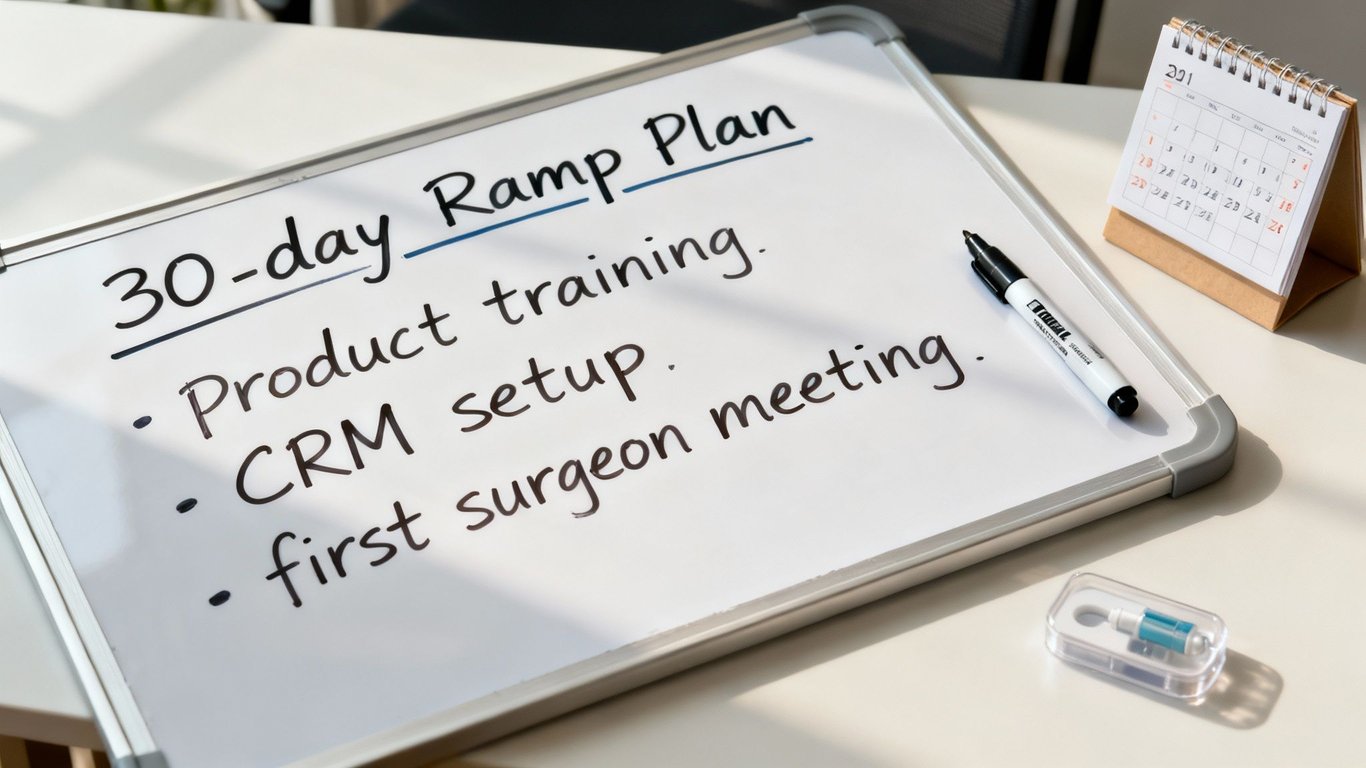
A signed contract is just the beginning. The first 30 days are critical and will determine whether a new hire becomes a high-performing team member or a statistic of churn.
A structured onboarding plan is essential for success. Without a clear path, even a seasoned representative can struggle. The objective is to equip them with everything they need to start booking meetings and building a pipeline quickly. This is not just "training" but a strategic launch sequence.
The First Two Weeks: Deep Product Immersion
The first two weeks should be dedicated to the product and its clinical application. A representative cannot sell what they do not understand thoroughly.
Your focus for weeks one and two should be practical:
- Product & Clinical Training: These sessions must cover the device's technical specifications, competitive advantages, and key differentiators. Provide clinical data and case studies they can use immediately.
- Real-World Shadowing: Arrange for them to shadow an experienced salesperson or clinical specialist during a real case or procedure. This is an invaluable learning experience.
- Systems Access & CRM Setup: Provide access to your CRM and other sales tools on day one. A quick-start guide helps them log contacts and track activity from the beginning.
The faster a rep understands the clinical value of your device, the more credibility they will have with surgeons and hospital administrators. Early confidence is crucial.
Weeks Three and Four: Activating the Territory
Once they have a solid grasp of the product, it is time to activate their territory. This is where their network merges with your company's strategic goals. The objective is to convert their network into sales activity.
This phase is about focused, immediate action:
- Strategic Territory Hand-Off: Provide a detailed breakdown of existing leads, high-priority target accounts, and any relevant historical data. No one should start from scratch.
- Craft the "First Call" List: Work with them to identify the top 10-20 high-potential physicians or hospitals within their existing network. This creates immediate momentum.
- Establish Early Performance Indicators: Set clear, achievable goals for their first 30, 60, and 90 days. Focus on leading indicators like meetings booked or new opportunities created in the CRM, not just the lagging indicator of a closed sale.
A structured plan ensures your investment in recruitment medical sales begins to pay dividends quickly. It gives your new representative a clear roadmap to turn their initial excitement into measurable results.
Answering Your Top Medical Sales Hiring Questions
When building a medical sales team, several key questions consistently arise. Here are answers based on industry experience to help you move forward with confidence.
What’s a Realistic Timeline for Hiring a Rep?
Aim to move from sourcing to a signed contract within 30 days. A longer process risks losing the best candidates.
Top representatives are always in demand, and a slow process signals disorganization. Using a specialized marketplace can shrink this timeline to one or two weeks by connecting you directly with vetted, active candidates.
The key to a fast hiring cycle is preparation. Have your ideal representative profile, interview questions, and contract ready before you begin sourcing. This maintains momentum.
How Much Should We Budget for Commission?
For independent medical sales reps, commission rates typically range from 20% to 30%. The final rate depends on your product.
Key factors include price point, sales cycle length, and market maturity. A disruptive technology requiring significant educational effort will command a higher commission to attract representatives willing to do the initial groundwork. For an established product in a competitive market, a rate closer to 20% is more common. A tiered structure is an effective way to motivate top performance.
Is It Better to Hire a W2 Employee or a 1099 Rep?
This decision involves a trade-off between control and speed/cost. Neither option is universally better, but one is likely more suitable for your current needs.
- W2 Employees are ideal when you require tight control over daily activities and your product necessitates deep, company-specific training.
- 1099 Independent Reps are the preferred choice for speed and market access. They allow you to cover territories quickly with experienced professionals who bring an existing book of business. The commission-only model minimizes your upfront financial risk.
If your goal is to enter a new territory and leverage existing surgeon relationships immediately, the 1099 model is almost always the most effective choice in medical device sales.
Ready to fill your empty territories with proven, commission-only medical sales talent? Zilla Sales connects you with a pre-vetted network of reps who already have the relationships you need. Post your opportunity and start matching with qualified candidates in under 48 hours. Find your next top performer at https://zillasales.com.
Keep Reading
More insights for high-performance sales teams.

A Modern Guide to B2B Door to Door Companies
Uncover how modern door to door companies work, the real costs, and the risks. Learn about a smarter alternative for fast B2B territory growth.

Mastering Software Sales Training for Elite Reps
Build a world-class software sales training program. This guide details the curriculum, metrics, and tools needed to accelerate revenue with your sales team.

How Does Commission Work in Sales? A Manufacturer’s Guide
Understand how does commission work in sales. This guide explains common structures, calculation examples, and best practices for B2B manufacturing companies.
Ready to find your sales partner?
Join manufacturers who are successfully expanding their territories with our network. Post a listing in minutes and start receiving matches.
✓ Verified Professionals • ✓ No Long-term Contracts