


At its core, a sales commission rate is the percentage of a sale that a salesperson earns. It is the most critical piece of any sales incentive plan because it directly ties a representative's compensation to their performance, ensuring their goals align with the company's objectives.
The Foundation of Sales Compensation

A commission rate formalizes the partnership between a company and its sales team. The company provides the product, marketing, and operational support. The salesperson brings the skill, network, and effort required to close deals. The commission rate determines how the revenue is shared, ensuring both parties are rewarded for business growth.
This rate is a strategic tool. An effective commission structure can direct your team toward specific goals, such as launching a new product or acquiring high-profit accounts. Conversely, a poorly designed rate can demotivate your team, create confusion, or encourage price-slashing behaviors that erode profitability.
How to Calculate Sales Commission
Calculating a commission payment is straightforward. The basic formula is universal, though the inputs can vary between businesses.
Commission Payment = Sale Amount × Commission Rate
Consider this practical example: a representative at a B2B equipment manufacturer closes a $50,000 deal. The company's commission rate is a straight 4% of the total deal revenue.
The calculation is as follows:
- $50,000 (Sale Amount) × 0.04 (4% Commission Rate) = $2,000 (Commission Payment)
For that single deal, the rep earns a $2,000 commission. This direct link between performance and compensation is what makes commission a powerful motivator.
Key Components in Your Calculation
While the formula is simple, the inputs you use are critical. The "Sale Amount" is not always the total contract value. It is essential to define what revenue base the commission is calculated on.
| Component | Description | Impact on Sales Behavior |
|---|---|---|
| Total Revenue | The full price of the sale. This is the most common and straightforward method. | Motivates reps to secure the largest possible deals but does not protect margins if discounts are offered. |
| Gross Margin | The revenue remaining after subtracting the cost of goods sold (COGS). This focuses on profitability. | Incentivizes reps to maintain pricing and avoid discounts, directly tying their compensation to the company's profitability. |
Choosing between a revenue or gross margin base is a strategic decision. A revenue-based rate is simple to calculate and easy for reps to understand, making it suitable for high-volume sales environments. However, for businesses with variable product costs, such as manufacturing, basing commissions on gross margin is a more effective strategy. It ensures the sales team is rewarded for generating profitable business, not just top-line revenue.
Choosing the Right Commission Structure for Your Business
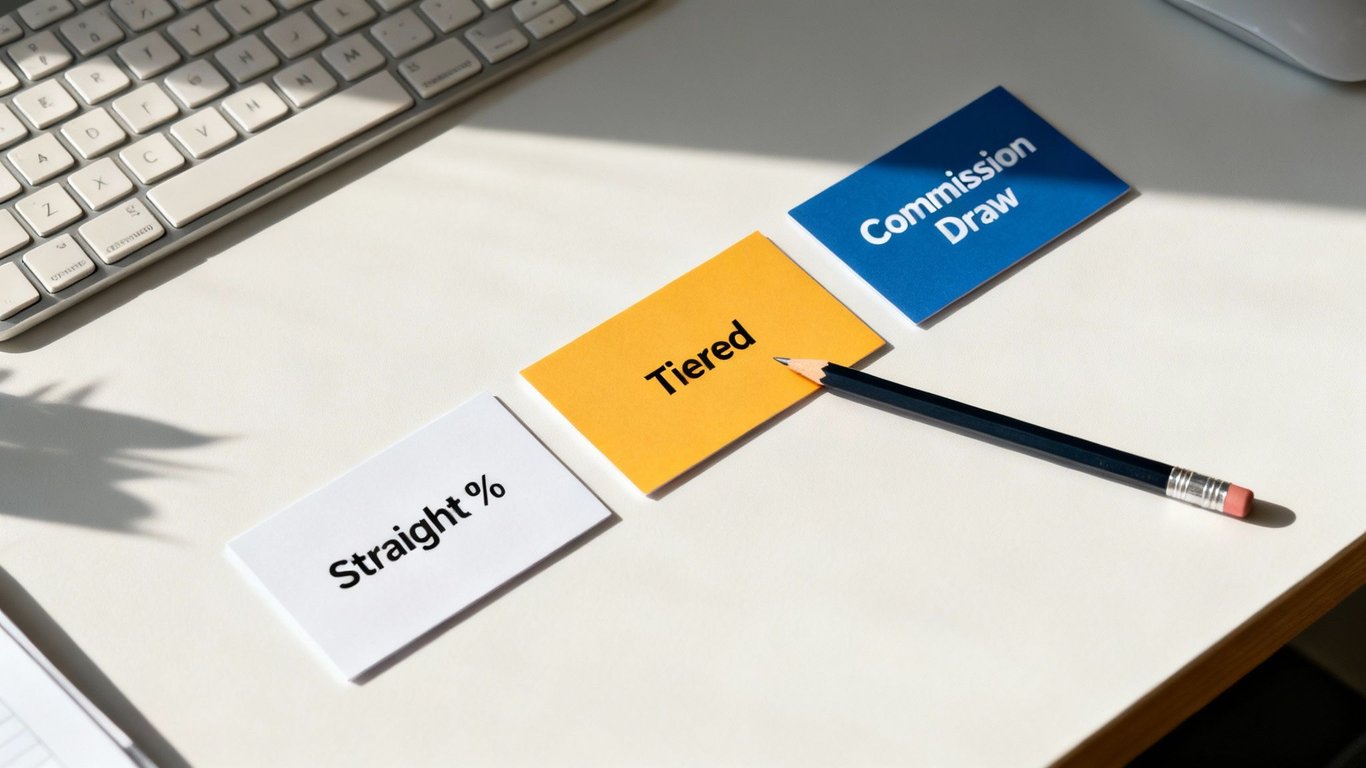
Selecting the right commission structure is about more than just payment processing; it's about incentivizing specific behaviors. An effective structure aligns your sales team's activities with the company's strategic goals. The key is to match the commission model to your business's sales cycle, product margins, and growth objectives.
Straight Percentage Commission
This is the most direct model. A salesperson earns a fixed percentage of every sale they make. Its simplicity is a key advantage, as representatives can immediately calculate their earnings on any deal.
For instance, a machine parts supplier might offer a flat 5% commission. If a representative sells $100,000 worth of parts in a month, their commission is $5,000. This model is well-suited for businesses with consistent pricing and a straightforward sales process.
However, a straight sales commission rate has limitations. It treats all revenue equally, failing to differentiate between an easy renewal and a challenging new customer acquisition. It also does not inherently incentivize sales of higher-margin products.
Tiered Commission
To motivate top performers, a tiered model is highly effective. With this structure, the commission rate increases as a salesperson achieves higher sales milestones within a defined period, such as a quarter. This approach gamifies performance, encouraging reps to continuously push for the next, more lucrative payout tier.
A tiered commission structure is an effective tool for driving growth. It directly rewards the effort required to exceed goals, making it ideal for new product launches or market share expansion.
Consider a software company with these quarterly tiers:
- Tier 1: 8% commission on sales up to $100,000
- Tier 2: 10% commission on sales from $100,001 to $150,000
- Tier 3: 12% commission on all sales above $150,000
A representative who closes $175,000 in a quarter sees their earning power accelerate. This model is excellent for fostering a strong "finish strong" mentality within a competitive sales team.
Commission Draw
A commission draw provides a financial buffer for representatives, which is particularly valuable in industries with long sales cycles or unpredictable sales volume. The company provides a regular payment—the "draw"—as an advance on future commissions.
Draws can be recoverable (the rep must repay it from future earnings) or non-recoverable. The recoverable model is more common.
For example, a company selling large-scale manufacturing equipment might offer a $4,000 monthly recoverable draw. If a rep earns only $2,500 in commission one month, they have a $1,500 deficit. If they earn $7,000 the next month, they first repay the $1,500 deficit and then take home the remaining $5,500. This structure offers stability while maintaining accountability.
A Comparison of Common Sales Commission Structures
This table provides a side-by-side comparison to help you determine which structure best fits your business goals.
| Structure Type | How It Works | Best For | Potential Downside |
|---|---|---|---|
| Straight Percentage | A fixed percentage of every sale. | Businesses with consistent pricing and short sales cycles. | May not incentivize selling high-margin products or new business. |
| Tiered Commission | The commission rate increases as sales targets are met. | Driving aggressive growth and motivating high performers. | Can be complex to administer and may demotivate reps far from the next tier. |
| Commission Draw | An advance payment against future commissions. | Companies with long, complex, or seasonal sales cycles. | Recoverable draws can create debt and stress for underperforming reps. |
Ultimately, the best structure is one that aligns with your company’s financial health and strategic objectives. Many businesses implement hybrid models, combining elements from different structures to create a customized compensation plan.
How Sales Commission Rates Vary By Industry

Establishing a competitive sales commission rate requires industry-specific knowledge. A rate that is attractive to a SaaS salesperson may not be compelling for a representative in industrial goods. Each industry is shaped by unique factors like product costs, sales cycle length, and average contract value.
Understanding these benchmarks is the first step toward building a compensation plan that is both sustainable for your business and attractive to the high-caliber, commission-only representatives you aim to recruit.
Manufacturing and Industrial Goods
In manufacturing, sales involve tangible products with significant material and production costs. This directly impacts commission structures. As profit margins are tighter compared to software, commission rates are typically lower.
However, a lower rate does not necessarily mean lower income. Manufacturing sales often involve large orders, long-term contracts, and consistent repeat business. A single representative might manage a portfolio of clients that generates high-volume orders monthly, creating a stable income despite a smaller percentage per sale.
The core logic is that a small percentage of a large, recurring order can be more lucrative than a large percentage of a small, one-time sale. This principle defines compensation in the manufacturing sector.
Independent representatives in this field understand these economics and seek opportunities that balance new business development with reliable, recurring revenue.
Technology and Software as a Service (SaaS)
In the technology sector, particularly Software as a Service (SaaS), the economic model is different. The cost of goods sold is minimal. Once the software is developed, the marginal cost of selling an additional subscription is nearly zero, resulting in high profit margins.
This high-margin environment allows for a much higher sales commission rate. It is not uncommon to see rates that are double or triple those found in manufacturing. The sales process also differs; representatives sell solutions and build strategic partnerships, requiring a unique skill set. To succeed, you need to find SaaS sales reps who understand this landscape.
Higher rates are necessary to reward what can be a more complex and less predictable sales cycle. SaaS reps invest significant effort in educating prospects, navigating buying committees, and acquiring new customers in a competitive market.
Benchmarking Your Commission Rate
Comparing industry benchmarks highlights these differences. According to industry data, a typical commission in manufacturing ranges from 1-5% of the sale value. In contrast, SaaS rates often start at 10%, while financial services can range from 10-20%.
The lower range in manufacturing reflects the volume-based nature of the business. Interestingly, recent data shows that while only 46.5% of sales teams hit their quotas, they still drove significant revenue. This highlights why tiered structures with accelerators are becoming more popular—they motivate reps to maximize every opportunity. You can find more insights on commission rates by industry from recent reports.
- Manufacturing: Success is based on volume and key account management. Lower rates are balanced by larger, recurring deals.
- Technology (SaaS): The focus is on value-based selling and new customer acquisition. High margins support higher commissions to reward new business development.
- Consumer Goods: This often involves distributors and retailers, so rates can vary depending on the sales channel and a product's lifecycle stage.
Your industry provides a baseline for setting commission rates. By understanding these benchmarks, you can design a plan that is not only competitive but also structured to drive the specific behaviors that will grow your business.
Key Factors That Influence Your Commission Rate
While industry benchmarks are a useful starting point, an optimal sales commission rate is tailored to the specific dynamics of your business. A rate that works for one company could be unsustainable for another in the same industry.
To design an effective plan, you must analyze your own business model. The goal is to create a structure that is competitive, motivating, fair, and financially sustainable, ensuring that every deal closed contributes to the company's progress.
Product Margin and Profitability
Gross margin—the profit made after subtracting the cost of goods sold (COGS)—is the single most important factor determining your commission rate. High-margin products provide more flexibility for offering higher commissions.
For example, a SaaS subscription has a near-zero marginal cost, leaving ample room to reward the salesperson. In contrast, selling heavy machinery involves significant material and labor costs, meaning the commission will be a smaller percentage of a larger total price.
This is why many companies base commissions on gross profit rather than total revenue. This strategic choice shifts a representative's focus from simply closing a deal to closing a profitable deal. It incentivizes them to protect pricing and avoid deep discounts, as their compensation is tied directly to the deal's profitability.
Average Deal Size and Volume
The typical size of a sale is another critical factor. If your business relies on a high volume of small, transactional sales, a lower commission rate is appropriate. The representative’s income is generated through the accumulation of many small wins.
Conversely, companies selling high-value items with fewer deals per quarter must offer a much higher rate. A salesperson may only close a few large deals per year, so each commission must be substantial enough to justify the long-term effort.
Consider these two scenarios:
- Scenario A: A parts supplier with an average order value of $500. A 3% commission ($15) is viable because a representative can close dozens of orders each week.
- Scenario B: An equipment manufacturer with an average system price of $250,000. A 5% commission ($12,500) is necessary to reward the significant effort and skill required to land such a large deal.
Length and Complexity of the Sales Cycle
Finally, consider the sales journey. A long and complex sales cycle requires significant time, energy, and expertise from a salesperson. To maintain motivation through months of demonstrations, follow-ups, and negotiations, the potential reward must be substantial.
Short sales cycles, common for simpler products, allow representatives to move quickly from one opportunity to the next. A lower commission rate is acceptable in this context. However, if your sales process involves navigating multiple departments, technical approvals, and large buying committees, a higher rate is essential to compensate for the extended effort and prevent burnout.
How to Hire Great Commission-Only Sales Reps

Once you have determined the optimal sales commission rate for your business, the next step is to attract top-tier, independent sales talent. Hiring commission-only representatives is about forming a strategic partnership. To succeed, you must present a clear, attractive, and mutually beneficial business proposition.
Crafting a Compelling Opportunity Listing
Your listing is the first point of contact with a potential sales partner. It must be professional, transparent, and focused on what experienced representatives value most: earning potential through their established networks.
Key elements to include are:
- A Clear and Enticing Headline: Avoid generic titles. Use specific language like, "Seeking Established Manufacturing Reps for High-Margin Industrial Product Line."
- The Commission Rate, Front and Center: State the rate clearly and specify whether it is based on revenue or gross margin. Transparency is valued by top performers.
- Realistic Earning Potential: Provide a tangible projection based on your average deal size and a conservative sales volume. For example: "With an average deal of $20,000 and a 10% commission, closing just two deals a month yields $4,000."
- Ideal Customer Profile: Clearly define your target market. This allows representatives to immediately assess if your product aligns with their existing contacts.
A well-crafted listing acts as a pre-qualifier. By detailing the target market and commission structure, you attract representatives who already have the right connections and are motivated by your specific compensation model.
Structuring the Independent Contractor Agreement
The independent contractor agreement formalizes the partnership and protects both parties. It must be unambiguous to prevent future disputes. This is where you document the sales commission rate and all operational expectations in writing.
Essential clauses include:
- Payment Terms: Specify when a commission is considered "earned"—upon contract signing or upon customer payment. Detail the payout schedule, such as net-30 from the end of the month the commission was earned.
- Territory Rights: Clearly define the geographic region, industry vertical, or specific accounts the representative will manage. State whether the territory is exclusive or non-exclusive.
- Termination Clause: Outline the process for ending the agreement and specify how commissions will be handled for deals already in the pipeline.
The compensation landscape is evolving. Traditional 50/50 splits in distributor-manufacturer relationships are becoming less common as business costs rise. This shift strengthens the case for working with independent reps who thrive on higher 10-15% rates for strong products, allowing companies to expand into new territories quickly. For more guidance, review our detailed guide on what to expect when working with commission-only sales reps.
Getting the Agreement Right: Negotiation and Legal Must-Knows
Setting your sales commission rate is a negotiation that establishes the tone for your partnership with a sales representative. The focus should not be on the percentage itself, but on the total earning potential.
Present the complete picture. A slightly lower rate on a high-ticket product that sells quickly can be more lucrative than a higher commission on a product with a year-long sales cycle. Model potential earnings: "Closing just three of our average deals per month at this rate will generate $X,XXX in income." This reframes the negotiation from a debate over a rate to a collaborative plan for achieving significant income.
Handling Special Requests and Sweetening the Deal
Experienced representatives may request a draw or an advance, particularly if your sales cycle is long. A recoverable draw can be an effective compromise. It provides the representative with a financial cushion while they build their pipeline, functioning as an advance against future commissions—a mutual investment in their success.
Accelerators are another powerful tool. If a representative requests a higher base rate, you can offer accelerators for exceeding quotas. This creates a win-win scenario: they gain access to higher earning potential, and you only pay top-tier rates for exceptional performance.
The Critical Difference: W-2 Employees vs. 1099 Contractors
Correctly classifying your sales team is a critical legal requirement. Misclassifying an employee as an independent contractor can result in significant penalties from the IRS, including back taxes and fines. The determining factor is the degree of control you exercise.
- W-2 Employees: You control their schedule, provide their equipment, and dictate how they perform their job. They are an integral part of your company's operational structure.
- 1099 Independent Contractors: They operate as their own business. They set their own hours, use their own tools, and determine their own methods. You control the result of their work, not the process.
For purely commission-based roles, the 1099 model is typically the appropriate classification. It aligns with the entrepreneurial nature of successful salespeople. To understand this topic in more detail, read our guide on hiring 1099 sales reps for your business.
A comprehensive, clearly written agreement is essential. It should explicitly state the contractor relationship and detail all aspects of the partnership to prevent future misunderstandings and legal complications.
Digging Deeper: Common Questions About Sales Commissions
Designing a sales commission plan can be complex. Here are answers to some of the most frequently asked questions.
What’s a Fair Commission Rate for a New Product?
Launching a new product requires representatives to educate the market and overcome initial resistance. To compensate for this increased effort, the commission rate for a new product should be higher than for established offerings.
A practical approach is to offer a rate 2-5% above your standard commission for the first 6-12 months. This "kicker" provides a strong incentive for your team to focus their energy on the new product, making the effort worthwhile.
Should We Pay Commission on Revenue or Gross Profit?
For most businesses with tangible product costs, paying commission on gross profit is the more strategic choice. It directly aligns the sales team's compensation with the company's profitability.
Paying on total revenue is simpler but can encourage discounting to close deals, even if it erodes margins. If you are a manufacturer or have significant costs of goods sold, a gross-profit model is critical for ensuring that sales activities contribute to the bottom line.
How Often Should We Revisit Our Commission Plan?
Review your commission structure at least annually. An annual review ensures your plan remains competitive in the talent market and continues to motivate your team toward current business goals.
Use this review to adjust for:
- Major shifts in the market
- New company objectives or growth targets
- Changes in your product lineup or pricing
However, do not wait for an annual review if you see clear warning signs. If your team is consistently missing quotas or a new competitor is disrupting the market, it is time for an immediate reassessment. Proactive adjustments can prevent significant drops in motivation and performance.
Ready to stop searching and start selling? Zilla Sales connects you with vetted, commission-only sales reps who have the industry relationships to hit the ground running. Post your opportunity for free and find the perfect partner to fix your empty territories fast. Build your high-performance sales team today.
Keep Reading
More insights for high-performance sales teams.

A Modern Guide to B2B Door to Door Companies
Uncover how modern door to door companies work, the real costs, and the risks. Learn about a smarter alternative for fast B2B territory growth.

Mastering Software Sales Training for Elite Reps
Build a world-class software sales training program. This guide details the curriculum, metrics, and tools needed to accelerate revenue with your sales team.

How Does Commission Work in Sales? A Manufacturer’s Guide
Understand how does commission work in sales. This guide explains common structures, calculation examples, and best practices for B2B manufacturing companies.
Ready to find your sales partner?
Join manufacturers who are successfully expanding their territories with our network. Post a listing in minutes and start receiving matches.
✓ Verified Professionals • ✓ No Long-term Contracts