


Effective software sales training is more than a product walkthrough. It is a comprehensive system designed to equip your reps with the knowledge, processes, and skills needed to sell sophisticated software. The goal is not just to explain features; it is to teach reps how to connect those features to real business value, navigate complex objections, and ultimately, close larger deals more efficiently.
Building a Modern Software Sales Training Program

Before scheduling a role-play or building a slide deck, you must lay the groundwork. A modern training program is not an administrative task; it is a revenue engine.
The objective is to build a repeatable system that produces high-performing reps, not just individuals who can recite a feature list. This begins with defining what success looks like in clear business terms. Move beyond vague goals like "better-trained reps" and focus on outcomes that impact the bottom line.
Set Goals Tied to Business Outcomes
Your training program must solve real problems. Start by pinpointing the specific metrics you want to improve. This focus will guide every component of your curriculum and prove its value later.
Consider goals like these:
- Reduce Ramp-Up Time: How quickly can a new rep—especially an independent one—secure their first win? A structured training plan can significantly decrease this time. For example, some companies have cut onboarding time by as much as 50% through targeted programs.
- Increase Average Deal Size: Train reps to identify upsell opportunities and confidently articulate the value of premium tiers to prevent leaving revenue on the table.
- Improve Win Rates: When competing directly, reps need the right intelligence and objection-handling skills to succeed. Well-trained teams can see 20-30% higher win rates.
- Ensure Message Consistency: Every rep should be able to articulate your company's story and unique value proposition in a consistent and compelling manner.
A well-designed training program transitions from a cost center to a direct investment in your sales pipeline. It provides reps with the playbook and the confidence required to execute your strategy effectively.
This is a strategic imperative. The market for sales training software reached USD 3.4 billion in 2024 and is projected to grow to USD 12.2 billion by 2034. This growth is driven by companies recognizing the tangible return on investment from effective training methodologies.
Calibrate the Training Intensity
Not all software is created equal, and neither are your sales reps. A one-size-fits-all training program is ineffective. You must calibrate the intensity based on your product's complexity and your reps' experience level.
Selling a simple, transactional browser plugin is fundamentally different from selling a complex enterprise platform with a six-month sales cycle. Similarly, an industry veteran with a decade of software sales experience requires a different onboarding track than a sharp but new rep. You can learn more about the unique challenges and needs of different sales professionals by exploring our guide on SaaS sales reps.
When you tie your training to measurable business goals and customize it for your product and team, you are building a strategic asset for growth.
Designing a High-Impact Training Curriculum
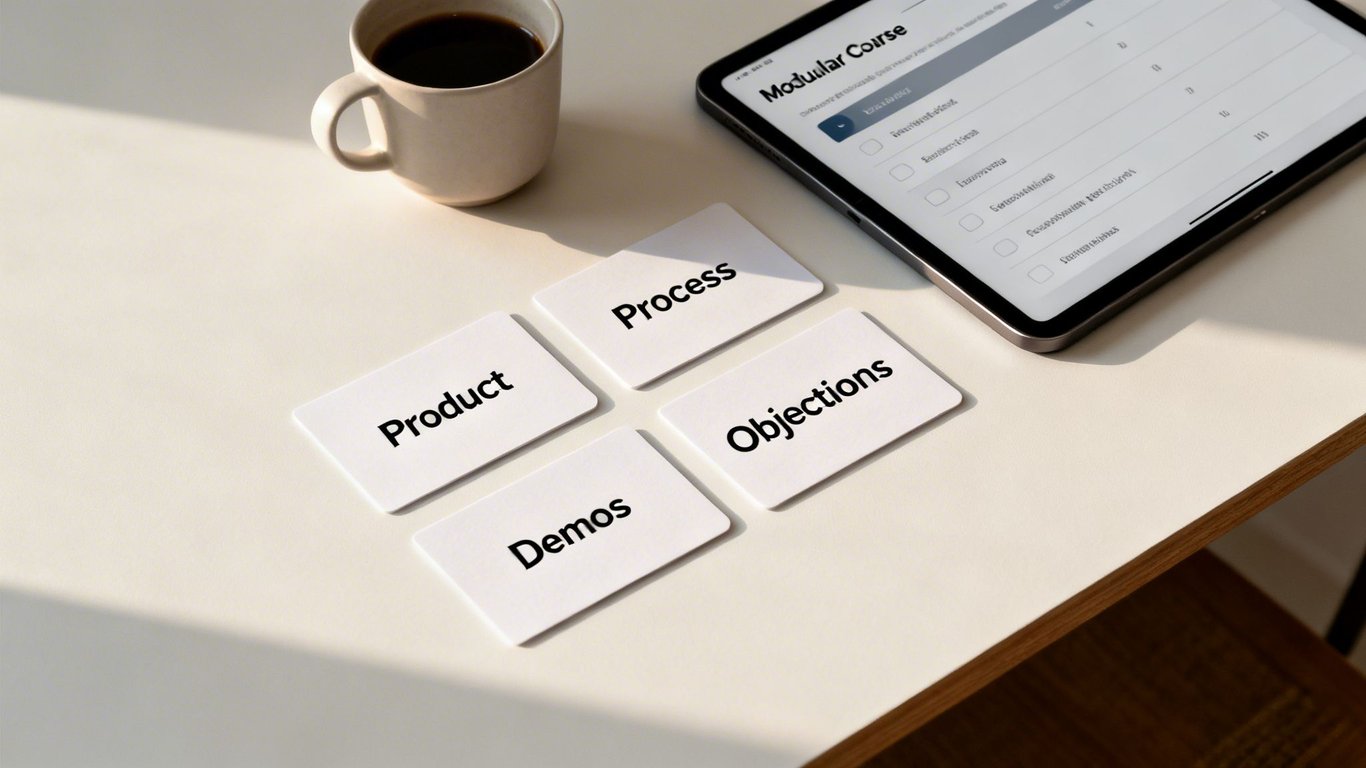
A great training curriculum is not a one-time webinar. It is a living resource that sales reps can access continuously. For independent reps paid purely on results, training must be ruthlessly practical and directly tied to closing deals.
Content should be modular and on-demand, allowing them to access exactly what they need, when they need it.
The best training programs are built on four core pillars: mastering the product, executing the sales process, delivering effective demos, and handling objections. Excelling in these four areas provides your reps with the foundation needed to succeed.
Go Beyond Features: Teach True Product Mastery
Knowing what a feature does is the bare minimum. True product mastery involves understanding why it matters to a specific customer. Who is it for? What specific problem does it solve? And how does it differentiate you from the competition?
Your training needs to shift reps from listing features to articulating business value.
For example, do not just tell them about the "analytics dashboard." Show them how to explain that the dashboard helps a VP of Operations reduce supply chain costs by 15% by instantly identifying critical bottlenecks. That is the type of value-based conversation that closes deals.
A powerful tool for this is the competitive battle card. This serves as a quick reference guide for direct competitive situations.
- Our Key Strengths: What are the 3-4 things we do better than anyone else?
- Competitor Weaknesses: Where do they fall short? What questions can we ask to subtly highlight those gaps?
- "Landmine" Questions: What can a rep ask that makes the prospect reconsider the competitor's solution?
- Pricing Traps: How do competitors use complex pricing to appear cheaper than they are?
Battle cards transform passive knowledge into an offensive strategy, giving your team the tools to position your software as the only logical choice.
A well-designed curriculum breaks these pillars into digestible modules. Here is a look at what that structure should cover for your independent sales team.
Essential Software Sales Training Curriculum Modules
| Module | Objective | Key Topics to Cover |
|---|---|---|
| Product & Industry Mastery | Equip reps to speak fluently about the problem, the solution, and the competitive landscape. | Ideal Customer Profile (ICP), buyer personas, core value proposition, competitor battle cards, industry trends, and key terminology. |
| The Sales Process | Provide a clear, repeatable roadmap for guiding a prospect from initial contact to a closed deal. | Prospecting strategies, lead qualification criteria (BANT, MEDDPICC), discovery call frameworks, follow-up cadences, and CRM best practices. |
| Selling Skills & Techniques | Develop the core competencies needed to manage conversations, build rapport, and create urgency. | Active listening, storytelling, framing value & ROI, needs analysis, and advanced questioning techniques (SPIN selling). |
| Demos That Sell | Teach reps to deliver compelling, prospect-centric demos that lead to a "yes." | Demo prep checklists, structuring the demo narrative, focusing on "aha!" moments, and avoiding feature-dumping. |
| Objection Handling | Arm reps with the confidence and frameworks to navigate tough questions and concerns. | Common objections (price, timing, competition), validation techniques, reframing cost as an investment, and negotiation tactics. |
This modular approach allows reps to focus on areas where they need the most help, making the training more efficient and impactful.
Nailing the Software Sales Process
A defined sales process is a rep's guide from a cold lead to a satisfied customer. While every deal is unique, the fundamental stages are generally consistent. Your training must provide clear instructions, templates, and expert tips for each step.
Here is what that journey typically looks like:
- Prospecting & Qualification: Where do we find our Ideal Customer Profile (ICP)? What signals indicate they are ready to buy?
- Discovery: This is where deals are won or lost. Reps must be trained to uncover deep business pain, not just surface-level needs.
- Demo & Value Pitch: Connect the pain points from discovery directly to the solutions in your software with a personalized demo.
- Proposal & Negotiation: Frame the price around value and ROI, and navigate the procurement process effectively.
- Closing: Secure the contract and ensure a smooth handoff to the customer success team.
The aim is not to create a rigid script. It is to build a repeatable framework that provides structure while allowing reps the flexibility to adapt to the conversation.
Delivering Demos That Actually Sell
A software demo is a sales presentation, not a user-training session. The worst mistake a rep can make is to "show up and throw up"—clicking through every menu and feature. This is a certain way to lose a prospect's interest.
An effective demo tells a story where the prospect is the main character.
The entire presentation should be tailored to the specific challenges uncovered during the discovery call. The best training teaches reps to keep demos concise—ideally 15 minutes max—and to focus only on the parts of the software that solve the prospect’s most significant problems.
If their main issue is poor team collaboration, spend 80% of the demo on your collaborative workflows. Do not mention the advanced reporting module if it is not relevant. You are not just showing them software; you are showing them a better future for their business.
Handling Objections and the Price Question
Objections are not a "no." They are a request for more information, and top performers see them as an opportunity to build trust. Your curriculum must include a playbook for handling common pushback.
For the classic "Your price is too high" objection, train reps on a simple framework:
- Acknowledge & Validate: Start with, "I understand, budget is always a key consideration." This demonstrates that you are listening.
- Isolate the Objection: Ask, "Putting price aside for a moment, does the platform itself seem like it would solve the challenges we discussed?" This ensures you have established value.
- Reframe with ROI: Pivot back to value. "When we talked about reducing X by 20%, that would save your company more than the cost of the software in just six months. How does that align with your financial goals?" This shifts the conversation from an expense to a strategic investment.
Providing reps with proven frameworks like this empowers them to handle tough conversations effectively. This is critical for anyone working as commission-only sales reps, as their income depends on navigating these final hurdles.
Getting Reps Ready for the Real World with Role-Play

Theoretical knowledge often fails under the pressure of a live sales call. The most successful training programs bridge the gap between knowing what to do and doing it through hands-on practice.
Role-playing and scenario-based training are crucial here. They create a safe environment for reps to practice their pitch, handle tough questions, and sharpen their skills before a real commission is on the line. Think of it as a flight simulator for sales—a place to make mistakes without real-world consequences.
Build a Library of Realistic Scenarios
Generic role-play exercises are a waste of time. For this to be effective, the scenarios must feel real. They need to mirror the exact challenges your reps will face.
The best way to do this is to build a library of situations tailored to your product, market, and buyer personas.
Start by consulting your seasoned reps and customer success managers. Ask them: What are the critical moments in our sales cycle? Where do new hires consistently struggle?
Your library should cover the entire sales journey. Here are a few examples:
- The Skeptical CTO: A demo where the technical buyer relentlessly challenges your security and architecture.
- The Procurement Negotiation: A call with a procurement officer demanding discounts and contract redlines.
- The Competitor Ambush: A scenario where the prospect mentions they are in final negotiations with your biggest competitor.
- The Hesitant Champion: A call where your internal advocate is getting cold feet and struggling to secure buy-in from their team.
Creating specific, real-world situations like these prepares reps for the friction they will inevitably face.
How to Run Effective Role-Play Sessions
An effective role-play session requires structure and constructive feedback. The goal is not a flawless performance but to identify areas for improvement in a supportive setting.
A powerful method is "Record, Review, Revise."
- Record the Session: Use your video conferencing tool or a platform like Gong to record the entire role-play. This captures words, tone, and body language.
- Review Together: The rep and manager (or a peer) watch the recording. Have the rep self-assess first. Ask what they thought went well and where they struggled.
- Revise the Approach: Provide specific, actionable feedback. Instead of saying, "You need to sound more confident," try, "When they pushed back on price, let's work on reframing it around the ROI we uncovered during discovery."
The objective is to build confidence, not diminish it. The feedback loop must be positive and focused on small, incremental improvements. Reps should view role-play as a tool for growth, not a test they can fail.
This kind of active learning is why the IT and telecom sector is expected to drive the sales training software market to a 17.01% CAGR through 2032. This growth is fueled by the need for tools with AI assessments and simulations—ideal for getting independent reps proficient with complex software. You can review the data in the latest sales training software market report.
Using a Simple Scorecard to Track Progress
To keep feedback objective and track improvement over time, use a simple scoring rubric. It helps both the rep and the coach focus on the most important skills and creates a clear benchmark for progress.
This does not need to be complex. Focus on 4-5 core competencies and rate them on a simple 1-5 scale.
| Skill Area | 1 (Needs Improvement) | 3 (Meets Expectations) | 5 (Exceeds Expectations) |
|---|---|---|---|
| Active Listening | Talked over the "prospect" and failed to ask clarifying questions. | Asked relevant questions but occasionally jumped to conclusions. | Asked insightful follow-up questions that uncovered deeper needs. |
| Value Articulation | Focused heavily on features without connecting them to business problems. | Connected features to the prospect's stated needs. | Told a compelling story, framing the software's value in terms of clear ROI. |
| Objection Handling | Became defensive or immediately offered a discount when challenged. | Used a basic framework to address the objection but lacked confidence. | Validated the concern, isolated the issue, and confidently reframed the conversation. |
| Call Control | Allowed the prospect to completely derail the agenda and conversation. | Followed a clear agenda but struggled to bring a meandering conversation back on track. | Masterfully guided the conversation, managed time, and set clear next steps. |
With a structured approach, role-play becomes a measurable, repeatable coaching tool. It gives your reps a safe environment to practice, fail, and ultimately perfect their craft before they are in front of a real prospect.
Building Your Sales Enablement Tech Stack
Placing a top-tier sales rep in the field with subpar tools limits their potential. Great software sales training extends beyond product knowledge; it involves arming your team with the right technology and resources to execute their strategy flawlessly.
The foundation of this support system is a world-class sales playbook and a carefully selected tech stack. These are not just amenities; they are force multipliers. They automate routine tasks, surface critical insights, and ensure every seller can access the right information at the right moment. This immediate access is what reduces ramp time and helps reps close deals faster.
The Sales Playbook: Your Single Source of Truth
Before investing in software, you need to build your sales playbook. This is the definitive guide to selling your product. It is the centralized resource that eliminates guesswork and ensures everyone, from new hires to veteran sellers, operates from the same strategy.
Treat it as a living document, not a static PDF.
A truly useful playbook must include:
- Ideal Customer Profiles (ICPs) and Buyer Personas: Be specific. Who are your best customers? What are their titles, challenges, and motivations for buying?
- Core Messaging and Value Proposition: Define the clear, concise statements that explain why your software is the solution and how it differs from competitors.
- Email and Call Scripts/Templates: Provide proven outreach sequences for every stage—from the initial cold email to the post-demo follow-up.
- Case Studies and Testimonials: This is your social proof. Organize it by industry or use case so reps can quickly find a relevant story.
Your playbook is the strategic core of your sales operation. It captures the collective wisdom of your best performers and makes it accessible to every rep.
Once you have this resource, choosing your technology becomes much simpler. You will know exactly what content to provide your team and which parts of your sales motion need technological support.
Essential Tools Beyond the CRM
Your CRM is the heart of your operation. However, a modern software sales team needs a few more specialized tools to achieve peak performance. The key is to select platforms that are user-friendly, deliver a clear return on investment, and integrate with your existing systems.
Learning Management System (LMS) This is where your training curriculum resides. An LMS is how you deliver on-demand courses, house your playbook and battle cards, and track training completion. For independent reps who are often learning on the go, a clean, mobile-friendly LMS is a necessity.
Conversation Intelligence Platforms Tools like Gong or Chorus provide immense value. They record, transcribe, and analyze sales calls, using AI to pinpoint key moments, track talk-to-listen ratios, and reveal how top reps handle objections. This enables you to provide specific, data-driven coaching instead of relying on subjective feedback.
Demo Automation and Creation Tools Not every lead is ready for a full live demo. Demo automation platforms like Walnut or Reprise allow you to create interactive, personalized product tours that prospects can explore at their convenience. This is an excellent way to qualify leads and ensure that when your reps conduct a live demo, it is with a highly engaged, educated buyer.
Selecting the right technology can be daunting, but the focus should be on solving specific problems. Start with a comprehensive playbook, identify the biggest friction points in your current sales process, and then find tools that directly address those challenges. This approach ensures your tech stack empowers your reps instead of just adding another login to their workflow.
How Do You Know If Your Training Actually Works? Measure It.
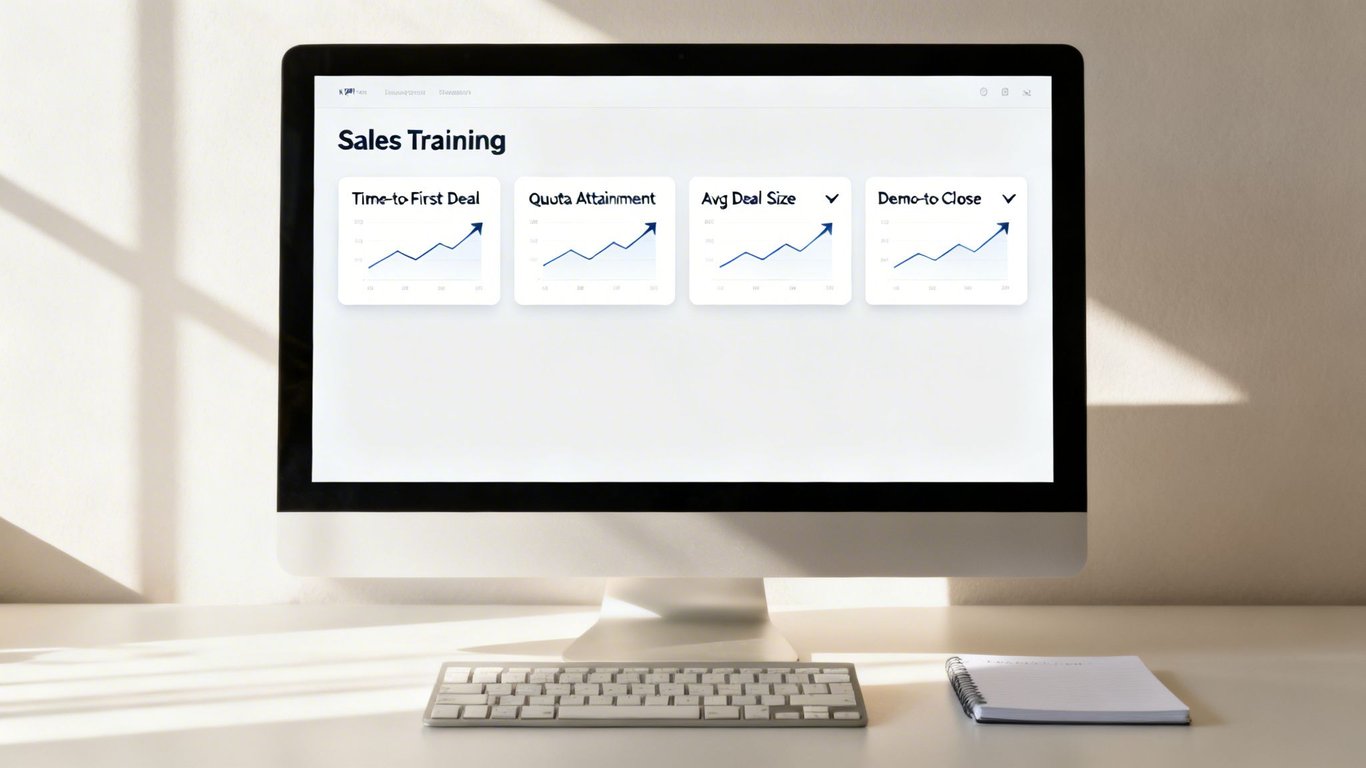
If you cannot measure your sales training, you cannot prove its value. It is easy to track metrics like course completion or quiz scores, but these numbers do not indicate a rep's ability to close a deal.
To genuinely gauge effectiveness, you must connect your training activities directly to sales outcomes. This involves moving beyond vanity metrics and focusing on the Key Performance Indicators (KPIs) that tell the real story. It is the only way to justify the investment and identify where your reps need more coaching.
First, Get Your Baseline
Before you can measure improvement, you must know your starting point. Establish a clear performance baseline for every rep—and the team as a whole—before any new training begins.
This pre-training snapshot is your benchmark. I recommend collecting at least one full quarter's worth of data on the metrics that truly matter. Without this historical context, any perceived improvements are just speculation.
Core Metrics That Tie Training to Revenue
Your sales dashboard should be focused and clear. It needs to highlight a handful of powerful KPIs that show how well your team is performing and how quickly new reps are ramping up.
Here are the non-negotiables:
- Time to First Deal: This is the ultimate test of your onboarding. It measures the number of days from a rep's start date to their first closed-won deal. A shorter timeframe indicates your training is preparing them to sell quickly.
- Quota Attainment: A classic metric for a reason. What percentage of your reps are hitting their targets? Tracking this trend over time provides a direct view of the team's overall capability.
- Average Deal Size: Is your training helping reps sell value, not just features? If this number increases, it means they are becoming more effective at selling premium tiers and pushing back on discount requests.
- Demo-to-Close Rate: This metric is critical. It shows how effectively a rep can convert an interested prospect into a paying customer. A rising conversion rate here is a strong signal that your demo and objection-handling training is effective.
The goal is to shift the conversation from, "Did they finish the training module?" to "How did the training impact their performance?" This change is fundamental to building a team that is always improving.
Keeping Score with a Sales Dashboard
Once you have your baseline, you need a simple way to monitor these KPIs. A visual dashboard, updated monthly or quarterly, provides an instant snapshot of rep progress and program ROI. It is an invaluable tool for spotting trends, identifying reps who need extra support, and reinforcing the training that is clearly driving results.
For example, you might notice that reps who excelled in the advanced negotiation module now have a 15% higher average deal size. That is a clear win.
This data-driven approach is why the sales training software market is on track to grow from USD 2.68 billion in 2024 to USD 6.11 billion by 2030. Companies are investing because they see the results—structured training that tracks skills can lead to 20-30% higher win rates. You can review the research driving this industry growth for more details.
When you start measuring what matters, you transform your software sales training from an expense into a proven engine for growth.
Below is a quick-reference table outlining the most critical KPIs to focus on.
Key Performance Indicators for Software Sales Training
| Metric (KPI) | What It Measures | How to Track It |
|---|---|---|
| Time to First Deal | The speed and effectiveness of your onboarding program. | Track the number of days between a new rep's start date and the close date of their first deal in your CRM. |
| Quota Attainment % | The overall productivity and sales capability of the team. | Divide the total sales generated by the team's quota for a given period (month/quarter). Monitor individual and team trends. |
| Average Deal Size | The rep's ability to communicate value and upsell. | Sum the value of all closed-won deals in a period and divide by the number of deals. Compare post-training vs. pre-training. |
| Demo-to-Close Rate | The effectiveness of a rep's demo, objection handling, and closing skills. | Divide the number of closed-won deals by the total number of demos conducted. Track this for each rep over time. |
| Sales Cycle Length | A rep's efficiency in moving deals through the pipeline. | Calculate the average number of days from initial contact to a closed deal in your CRM. Shorter cycles often indicate better qualification. |
This is especially important when working with commission-only reps, since their pay is tied directly to performance. To align your training even better, check out our guide on how commission works in sales.
Answering Your Top Questions About Software Sales Training
Even with a well-structured plan, questions will arise. This is particularly true when training independent or commission-only reps, who have different motivations than a typical in-house team. Your training must respect their entrepreneurial drive.
Here are some of the most common questions from those building out their training programs, with direct, practical advice you can apply immediately.
How Long Should Onboarding Take for a New Software Sales Rep?
For an independent rep, time is money. They cannot afford a prolonged onboarding process. The goal should be to get them ramped up and actively selling within a tight 30-day cycle.
A realistic timeline can be broken down as follows:
- Week 1: The Foundation. This week focuses on the fundamentals: your product, your ideal customer profile (ICP), and the tech stack they will use daily (CRM, learning platforms, etc.). The goal is for them to absorb enough core knowledge to be credible.
- Weeks 2-3: Practical Application. This period should be filled with hands-on exercises, such as discovery call role-plays, drills using competitive battle cards, and a mandatory demo certification before they engage with a real prospect.
- Week 4: Go Live. By the final week, the rep should be engaging with their first few leads. However, they are not alone. Ensure they have access to support and coaching as they navigate real-world conversations.
This accelerated timeline is only possible if all your training content is prepared in on-demand, bite-sized modules. This respects their schedule and allows them to review complex topics as needed.
What Is the Most Important Skill to Teach in Software Sales?
While deep product knowledge is important, it is not the most critical skill.
The single most critical competency in software sales is active listening during discovery. Too many reps are trained to pitch; the best are trained to diagnose.
Effective discovery is what separates average sellers from elite performers. It is how you uncover a prospect's true pain points, business goals, and operational challenges. Without this intelligence, your demo is just a generic product tour that will likely fail to resonate.
Your training must dedicate significant time to discovery call role-plays and reviewing actual call recordings. Teach your reps to ask intelligent, open-ended questions that make the prospect think. When a rep can accurately diagnose the problem, tailoring the solution becomes second nature.
How Do You Keep Commission-Only Reps Engaged in Ongoing Training?
For a commission-only rep, engagement depends on one question: "Will this help me make more money?" If the answer is not a clear and immediate "yes," you will lose their interest. They are entrepreneurs, and their time is their most valuable asset.
To maintain their engagement, your ongoing training must be:
- Concise and relevant. Deliver content in short, practical bursts. A 20-minute webinar on a specific objection is valuable. A two-hour lecture is not.
- Peer-led. Have your top-performing reps lead sessions on what is working for them right now. Hearing from someone actively closing deals provides a level of credibility that is hard to replicate.
- Competitive. Introduce gamification elements. Leaderboards for module completion or small incentives for reps who successfully use a new tactic to close a deal can be highly effective.
Every piece of training must solve a real-world problem they are facing today, not a theoretical issue they might encounter in the future.
What's a Common Mistake When Training Independent Sales Reps?
The most common mistake is forcing independent reps through a generic, one-size-fits-all training program designed for entry-level, full-time employees. This approach completely misunderstands their needs.
These reps are not beginners who need to learn basic sales principles. They are seasoned professionals who have chosen to partner with you. They do not need to learn how to sell; they need to learn how to sell your software.
Your training must be a strategic resource, not a remedial course. It needs to be hyper-specific to your product, your market, and your buyer personas. Show respect for their experience by focusing only on the specialized knowledge they need to represent your brand and succeed.
Of course, finding independent reps who are ready for this kind of high-impact training is the first step. At Zilla Sales, we connect you with a network of verified, industry-specific sales pros actively looking to add new products to their book of business. Fix your empty territories and start selling faster by exploring our marketplace.
Keep Reading
More insights for high-performance sales teams.

A Modern Guide to B2B Door to Door Companies
Uncover how modern door to door companies work, the real costs, and the risks. Learn about a smarter alternative for fast B2B territory growth.

How Does Commission Work in Sales? A Manufacturer’s Guide
Understand how does commission work in sales. This guide explains common structures, calculation examples, and best practices for B2B manufacturing companies.

Setting Fair Commission Sales Rates for B2B Manufacturers
Learn how to set effective commission sales rates for independent reps. Our guide covers models, industry benchmarks, and legal tips for manufacturers.
Ready to find your sales partner?
Join manufacturers who are successfully expanding their territories with our network. Post a listing in minutes and start receiving matches.
✓ Verified Professionals • ✓ No Long-term Contracts