


Setting the right commission sales rates is a critical business decision. A well-structured plan attracts top sales talent and drives company growth. A poorly designed one can lead to talent acquisition issues and threaten profitability.
For an independent B2B manufacturing representative, a commission-only plan is typically structured as 20% to 40% of the gross margin. When paying on total revenue, the rate usually falls between 5% to 15%, depending heavily on product margins and sales cycle complexity.
Choosing Your Foundational Commission Model
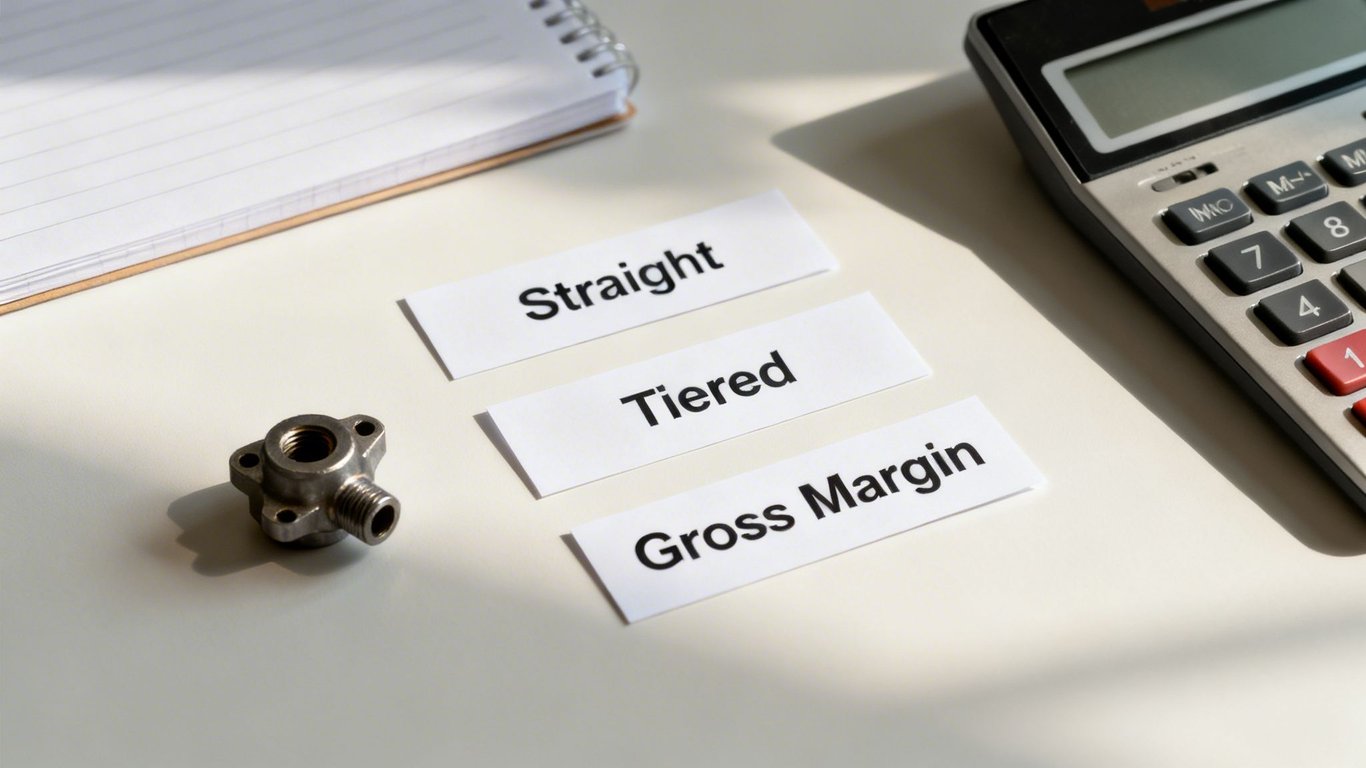
Your commission model is the foundation of your partnership with an independent sales force. It dictates sales behavior, impacts profitability, and determines your ability to attract top-tier representatives. The goal is to find a structure that incentivizes reps to sell in a way that maximizes their earnings while strengthening your bottom line. Effective structures are clear, fair, and directly tied to key business objectives.
H3: Revenue vs Gross Margin Models
The first decision is whether to base commissions on total revenue or gross margin.
A revenue-based commission is straightforward. It is easy to calculate and is effective when product margins are consistent. This model is ideal for companies focused on increasing sales volume and market share. For example, a company selling standard industrial components with predictable costs might offer a flat 7% commission on all sales revenue to encourage reps to focus on closing larger deals.
However, for businesses with variable product profit levels or where reps can negotiate discounts, a gross-margin model is essential. This structure protects profitability by linking a representative's compensation directly to the actual profit on a sale. It ensures that reps are motivated to sell profitably, not just to sell. A B2B manufacturer that builds custom machinery with tight margins, for instance, needs this model to prevent discounts from eroding profits.
When you tie commission to gross margin, you're essentially turning your sales reps into strategic partners. They start thinking about profitability on every deal, ensuring that even a discounted sale is still a healthy win for the company.
H3: Straight vs Tiered Commission Rates
After choosing between revenue and margin, the next step is to select the rate structure.
A straight commission is the simplest approach, offering a fixed percentage on every sale. A rep might earn a flat 10% on the gross margin of every deal they close. This model is predictable and easy for everyone to understand and administer.
A tiered commission structure is designed to motivate top performers. With this model, the commission rate increases as the representative surpasses specific sales targets. It is a powerful tool for encouraging reps to exceed their goals.
Here is an example of a simple tiered structure:
- 10% commission on the first $250,000 in annual gross margin.
- 12% commission on any margin generated between $250,001 and $500,000.
- 15% commission on all gross margin above $500,000.
This structure creates a powerful incentive to keep selling. Representatives know their earning potential accelerates as they sell more, providing the motivation needed to fuel business growth.
A Quick Comparison of Commission Models
Choosing the right commission structure involves matching the model to your specific business goals, sales cycle, and desired sales behavior. Each approach has distinct advantages suited for different situations.
To simplify the decision, here is a breakdown of the most common models for manufacturers.
Comparing Common Sales Commission Models
| Commission Model | How It Works | Best For | Key Consideration |
|---|---|---|---|
| Straight Commission | A fixed percentage is paid on every sale (e.g., 8% of revenue). | Companies with consistent product margins and a primary goal of driving sales volume. | Simple and predictable, but may not incentivize reps to protect profitability if they can discount. |
| Tiered Commission | The commission rate increases as the salesperson reaches higher sales targets. | Motivating high performance and rewarding top sellers. Great for growth-focused companies. | Can be more complex to administer. Tiers must be challenging but realistically achievable. |
| Gross Margin Commission | Commission is calculated as a percentage of the profit on a sale, not total revenue. | Businesses with variable product margins or where reps have discounting authority. | Aligns sales goals directly with company profitability but requires transparent margin data. |
| Commission Against a Draw | Reps receive a base payment (a "draw") that is paid back from future commissions. | Providing a safety net for reps in roles with long sales cycles or inconsistent income. | A non-recoverable draw can be costly if reps don't perform. Ensure terms are legally sound. |
Ultimately, the best model is one that feels fair to the sales rep while protecting and advancing the financial health of your company. It should be a true win-win that drives the right actions and delivers the right results.
How to Benchmark Your Commission Sales Rates
Determining the right commission rate requires market awareness. Setting a rate that is too low will fail to attract experienced, independent representatives. Conversely, a rate that is too high without a firm grasp of your margins can damage your company's finances. The optimal approach is to benchmark against your industry to create an offer that is both competitive and sustainable.
This process should be data-driven to create an opportunity that appeals to the high-caliber professionals you need.
What Are Typical Commission Rates Across Industries?
Commission rates vary significantly across sectors, influenced by factors like product value, sales cycle length, and average profit margins. Understanding these differences is a critical first step.
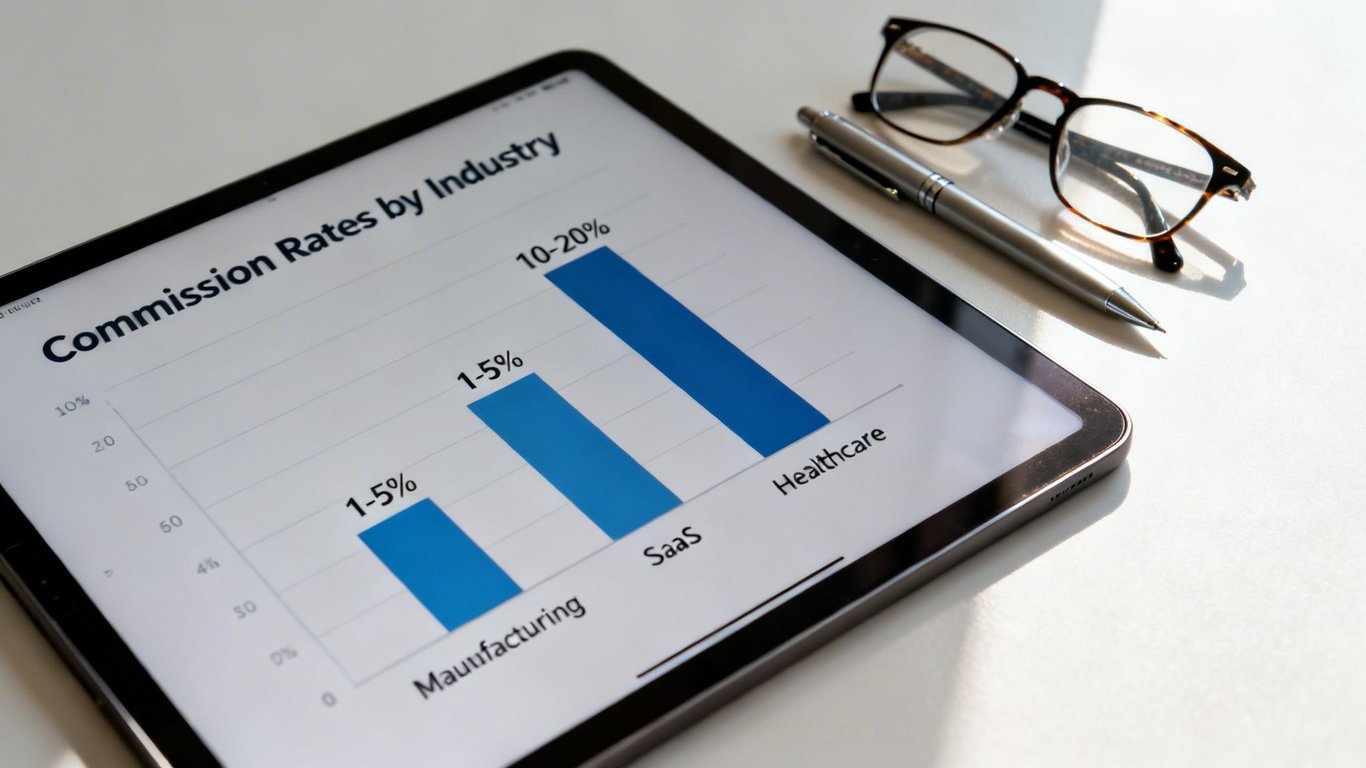
While a general average for sales commissions might be 5-20% of a sale's value, industry specifics provide a more accurate picture. In manufacturing, for instance, rates often fall into a more conservative 1-5% range on revenue due to slimmer margins on high-volume goods and long, complex sales cycles.
In contrast, industries like real estate or financial services can command rates of 10-20%, justified by high-ticket values and the potential for long-term, recurring revenue.
Here is a brief overview of typical rates in key sectors:
- Manufacturing: Typically 1-5% of revenue. More commonly, it is structured as 20-40% of gross margin to reward profitable sales rather than just volume.
- SaaS & Technology: A common standard is 10-20% of the annual contract value (ACV). The higher rate is viable due to the low marginal cost of adding new customers and the benefit of predictable, recurring revenue.
- Healthcare & Medical Devices: Rates vary widely, typically from 5-10%, depending heavily on the product—whether it's high-value capital equipment or disposable supplies that generate repeat orders.
Understanding these benchmarks is non-negotiable. A seasoned manufacturing rep will immediately know a 10% revenue commission is probably unsustainable for your business. Likewise, a SaaS rep will tune out a 2% offer. Your rate is a signal that you understand your own industry.
Why Your Industry Is the Deciding Factor
The significant differences in commission rates across industries exist to align compensation with the effort required and the profit generated. The structure must be logical for both the company and the representative.
For example, a representative who sells a $2 million piece of industrial machinery on a 3% commission earns $60,000. This substantial payout reflects a lengthy and technically demanding sales cycle.
In comparison, a software representative closing a $100,000 annual subscription at 15% earns $15,000. While the amount is smaller, the sales cycle was likely shorter, and the company gains a recurring revenue stream.
Each structure is designed to attract the right professional for that specific sales environment. To dig deeper, check out our guide on how to set the right sales commission rates.
Modeling Your Payouts for Profitability

Before finalizing any commission sales rates, it is imperative to model the financial outcomes. A common error is to select a rate that seems reasonable but ultimately erodes profit margins. This analysis is not just about protecting your bottom line; it is about ensuring the opportunity is attractive enough to secure experienced sales professionals.
The first step is to establish a clear understanding of your break-even point on every sale by accounting for all associated costs.
Calculating Your Break-Even Point
To determine your profit floor, subtract all direct and indirect costs from the sale price using this formula: Sale Price - Cost of Goods Sold (COGS) - Overhead Allocation - Commission = Net Profit.
Consider this example for a hypothetical industrial equipment manufacturer:
- Sale Price: They sell a piece of machinery for $500,000.
- Cost of Goods Sold (COGS): Direct costs for materials and labor are $300,000.
- Overhead Allocation: They calculate that 15% of the sale price ($75,000) is needed to cover indirect costs like rent, utilities, and administrative salaries.
- Proposed Commission Rate: They are considering a 3% commission, which amounts to $15,000 on this sale.
With these figures, the net profit is $110,000. This model confirms that a 3% commission is sustainable and leaves a healthy margin. This type of analysis prevents the creation of a compensation plan that could turn profitable sales into losses.
Modeling Rep Earnings to Attract Top Talent
It is equally important to analyze the compensation plan from the sales representative's perspective. Top performers evaluate business opportunities, not just jobs. A well-structured commission plan signals that you are serious about a mutually beneficial partnership.
Financial potential is a key factor. For instance, according to Xactly's 2023 compensation report, the average on-target earnings (OTE) for an account executive is approximately $139,000, with a 51/49 base/commission split. In some sectors, top earners exceed $275,000. You can see how industry benchmarks influence sales commissions on Salesforce.com. This data demonstrates that a well-designed plan creates the high-earning potential necessary to attract top talent.
Running payout scenarios is crucial. You need to see what a rep would earn at 50%, 100%, and 150% of their quota. If the on-target earnings don't look compelling, top-tier reps will simply look elsewhere.
Returning to the manufacturer example, a rep who achieves a $3 million annual quota would earn $90,000 in commissions. If they achieve $4.5 million, their earnings increase to $135,000. Presenting clear, achievable scenarios demonstrates that you are offering a genuine opportunity for significant income, making your role more attractive.
How to Pitch a Commission-Only Role
When recruiting a 1099 sales representative, it is essential to frame the position as a business opportunity, not just a job. The best independent reps operate like entrepreneurs, looking to add a new, high-margin product line to their portfolio. Your opportunity must stand out.
They are not seeking a manager; they are looking for a great product, a receptive market, and a fair compensation structure that respects their time and professional network. The entire pitch should be framed around mutual success and uncapped potential.
What Experienced Reps Actually Care About
An experienced representative will evaluate your offer based on three key factors: the product, the market, and the earning potential.
First, your product must solve a significant problem for a specific customer profile. It needs a clear competitive advantage. A successful representative must believe in the product they are selling.
Next, you must demonstrate the market potential. Provide data on the total addressable market (TAM), your ideal customer profile, and any existing sales. Independent reps view their territory as their business and need to know the market is viable.
Finally, be prepared to present the financial model. Clearly illustrate the earning potential with your commission sales rates so they can see what a top performer can achieve.
Many companies make the mistake of leading with their history or culture. An independent rep's first question is always, "Can I make serious money selling this to my network?" Your pitch has to answer that—loud and clear.
Talk to Them Like a Partner, Not an Employee
When writing the job description, avoid corporate jargon. Address them as the business owners they are. You are looking for someone who thinks in terms of revenue, margin, and return on investment for their time. You can learn more about attracting commission-only sales reps in our dedicated guide on the topic.
Use direct, powerful language that clearly outlines the proposed partnership.
- Uncapped Earning Potential: Emphasize that there is no limit to their income.
- Proven Product-Market Fit: Support this claim with testimonials, case studies, or early sales data.
- Protected Sales Territory: Offer an exclusive region or vertical to show you are serious about protecting their efforts.
- Sales & Marketing Support: Be specific about the resources you will provide, such as qualified leads, marketing materials, or technical support.
When you present the role as a strategic alliance, the conversation shifts from a job to a joint venture focused on profit. This approach is how you attract the most driven and effective independent representatives.
Structuring Your Independent Sales Agreement

When onboarding a commission-only sales representative, a verbal agreement is insufficient. A clear, legally sound independent sales agreement is essential. This document forms the basis of a healthy partnership, protecting both your company and the representative from future disputes.
The contract formalizes your arrangement, moving it from a casual conversation to a professional commitment. It establishes the rules of engagement upfront, preventing disagreements over commission sales rates, territories, and other key terms. It is about building a foundation of trust and transparency from the start.
Key Clauses to Include in Your Contract
A vague agreement can lead to problems. Your contract must be thorough, leaving no room for interpretation. Many promising partnerships have failed due to poorly drafted initial agreements.
Here are the essential clauses to include:
- Independent Contractor Status: This is critical. The agreement must explicitly state that the sales rep is a 1099 independent contractor, not a W-2 employee. This distinction is crucial for tax and legal purposes, clarifying their responsibility for their own taxes and ineligibility for employee benefits.
- Sales Territory: Be specific. Define the territory by geography (states or zip codes), industry vertical, or a list of named accounts. An exclusive territory can be a powerful motivator, so clearly define what "exclusive" entails.
- Commission Rate and Payment Schedule: Detail the exact commission percentage and clarify if it is based on revenue or gross margin. If using tiers, outline them clearly. Crucially, define when a commission is "earned"—upon invoicing or upon receipt of payment. Then, state the payment schedule (e.g., net 30 days from the end of the month).
- Termination Clause: All partnerships end. Outline the conditions under which either party can terminate the agreement. Include the required notice period and, most importantly, how commissions on pending deals or recurring revenue will be handled after the contract ends.
The real estate industry provides a clear example of why specific terms are important. For decades, U.S. commission rates were a standard 6%, but legal challenges and competition have pushed them down to around 5%. You can read more about how legal frameworks influence commission rates on HousingWire.com. This demonstrates how market forces and legal details can reshape industry standards.
A strong contract isn't about mistrust; it's about clarity. It ensures both you and your sales partner are perfectly aligned on every detail, from payout timing to territory rights, which prevents future conflicts.
Having a robust contract is non-negotiable for any serious business. To help you get started, we put together a comprehensive guide on sales commission agreement examples. Use it as a blueprint to ensure every aspect of your collaboration is clearly defined, protecting all parties and setting the stage for a profitable relationship.
Common Questions About Commission Sales Rates
As you finalize your commission structure, several common questions often arise. Addressing these practical details clearly from the outset is crucial for a successful partnership.
Answering these questions demonstrates to an experienced representative that you have thoroughly considered the arrangement and are committed to a professional relationship.
What Is a Typical Commission Rate for a New Product Launch?
Launching a new product requires significant effort from a sales representative. They are not simply taking orders; they are educating the market, overcoming skepticism, and establishing a new market presence. It is fair to compensate them for this additional work.
A common and effective strategy is to offer a temporary "kicker" or a higher commission rate.
For example, if your standard rate in manufacturing is 3-5% of revenue, you might increase it to 6-8% for the first six months. Alternatively, you could offer the higher rate until a specific sales milestone is reached, such as the first million dollars in sales. This higher rate acknowledges the initial effort and incentivizes reps to prioritize your new product. Once the product gains traction, the rate can revert to the standard as outlined in the agreement.
How Do I Handle Commissions on House Accounts?
"House accounts"—existing customers managed directly by the company—can be a source of conflict if not handled with complete transparency. This policy must be detailed in the contract.
There are a few ways to approach this:
- No Commission: Paying zero commission on existing business is an option, but it can demotivate a representative by providing no incentive to protect or nurture that revenue stream.
- Reduced Commission: A more common approach is to offer a smaller commission, such as 1-2%, for maintaining the relationship and serving as the local point of contact. This acknowledges their role in servicing the account.
- Commission on Growth: This is often the most effective solution. The representative earns their full, standard commission rate, but only on the revenue they generate above the account's historical baseline. This incentivizes them to expand the business, creating a win-win situation.
Regardless of the chosen method, ensure every house account is explicitly listed in the sales agreement from the beginning to avoid future surprises.
Transparency is everything when it comes to house accounts. A rep needs to know exactly which accounts are off-limits or have special terms before they sign. Surprising them with a long list of "no-commission" clients after the fact will destroy trust instantly.
Should I Base Commissions on Revenue or Gross Margin?
This choice depends on your business model and product mix. Paying commission on total revenue is simple and effectively motivates high sales volume. It is suitable if your profit margins are consistent across all products.
However, if your representatives have the authority to offer discounts or if you sell a mix of high- and low-margin products, a gross margin commission plan is almost always the smarter, safer choice.
Basing commission on gross margin aligns the sales representative's financial goals with your company's profitability. It encourages them to sell on value and protect margins, rather than offering deep discounts to close a deal. This structure transforms them into a true partner in the financial health of your business.
When Should I Pay Commissions to Independent Reps?
The timing of commission payments must be clearly defined in your contract. The two most common models are paying when the product ships (or when the invoice is sent) versus paying when the customer's payment is received.
Representatives often prefer to be paid upon invoicing, as it shortens their cash flow cycle. However, this model poses a risk to your company if the customer pays late or not at all.
For this reason, paying commission upon collection is the standard and safer practice for most B2B manufacturers, especially those with longer payment cycles. It ensures you are only paying commissions on cash you have received. Whichever method you choose, ensure it is applied consistently and is clearly stated in the agreement.
Ready to find experienced, commission-only sales reps who can hit the ground running? Zilla Sales connects you with a vetted network of industry professionals ready to represent your product line. Find your perfect match and fill your sales territories fast.
Keep Reading
More insights for high-performance sales teams.

A Modern Guide to B2B Door to Door Companies
Uncover how modern door to door companies work, the real costs, and the risks. Learn about a smarter alternative for fast B2B territory growth.

Mastering Software Sales Training for Elite Reps
Build a world-class software sales training program. This guide details the curriculum, metrics, and tools needed to accelerate revenue with your sales team.

How Does Commission Work in Sales? A Manufacturer’s Guide
Understand how does commission work in sales. This guide explains common structures, calculation examples, and best practices for B2B manufacturing companies.
Ready to find your sales partner?
Join manufacturers who are successfully expanding their territories with our network. Post a listing in minutes and start receiving matches.
✓ Verified Professionals • ✓ No Long-term Contracts