


For manufacturers, outsourcing appointment setters is a strategic play for aggressive growth. It provides direct access to specialized talent, letting your core sales team bypass the hiring process and focus on closing deals. When launching a new product or breaking into a new region, this approach helps you generate revenue quickly.
Why Smart Manufacturers Outsource Appointment Setting
In B2B manufacturing, a weak sales pipeline can threaten the business. The traditional method of hiring an in-house team of Sales Development Reps (SDRs) is slow and expensive. It involves recruitment fees, salaries, benefits, and overhead with no performance guarantee. This diverts time and resources from core competencies like engineering and product development.
When you outsource appointment setters, you shift from a fixed-cost model to a variable, performance-driven one. This provides the flexibility to scale your outreach up or down with market demand, without the human resources complexity of hiring and firing.
A Real-World Manufacturing Scenario
Consider a medical device manufacturer preparing to launch a new product line across three states. Their internal sales team is already at capacity managing existing accounts. Building a new in-house team to lead this initiative would take months—a critical delay they cannot afford.
Instead, they partner with a network of experienced, commission-only appointment setters. This single decision provides an immediate, significant advantage.
- Instant Access to Talent: They gain immediate access to a pool of proven professionals who already have established relationships with hospital procurement managers and surgical center directors.
- Reduced Time-to-Market: The outsourced team can begin outreach on day one. This shortens the time-to-first-sale from months to weeks.
- Minimized Financial Risk: With a commission-only structure, the manufacturer pays only for qualified meetings that lead to substantive sales conversations.
This agile approach avoids the high costs and slow ramp-up of a traditional hiring process. It allows your company to focus on its core strengths—building superior products and closing deals—while specialists manage the top-of-funnel prospecting.
The Strategic Shift from Cost to Growth
This strategy is effective for any business that requires both speed and precision. Instead of building a sales engine from scratch, you are effectively leasing a high-performance one.
By leveraging external expertise, manufacturers can penetrate new markets with greater efficiency and reduced guesswork. The logic is similar to working with specialized, independent representatives. You can find dedicated professionals, like the expert manufacturers' reps who already have relationships with your ideal buyers, and begin work immediately. This transforms appointment setting from an administrative task into a powerful engine for business growth.
Choosing the Right Appointment Setter Engagement Model

Before seeking talent, you must define what success looks like for your business. This is the foundation of a profitable partnership. A practical first step is to create a detailed "Setter Profile" that outlines your exact requirements.
This profile must be specific. Include target industries, ideal customer profiles (ICPs), and concrete, measurable goals. For example, a weak goal is "get more meetings." A strong goal is "secure 20 qualified meetings per month with plant managers in the Midwest automotive supply chain." This profile will guide every subsequent decision.
Once that is established, you can explore the different ways to outsource appointment setters. Each model offers a unique mix of cost, control, and scalability.
The Commission-Only Freelancer
The commission-only model is entirely performance-based. You pay an independent contractor only when they deliver a qualified meeting or a sale closes.
This is an attractive option for startups or manufacturers testing a new product, as it keeps upfront financial risk extremely low. You pay for tangible results, not hours worked. The challenge is that you need a compelling product and commission structure to attract top talent. The best commission-only setters are selective and will only represent products they believe in.
The Retained Agency Model
When you partner with a retained agency, you pay a fixed monthly fee for a dedicated team and a specific scope of work. This model is built on consistency and predictability, making it suitable for established companies entering a new market or scaling outreach in a structured manner.
An agency provides experienced managers, proven processes, and access to sophisticated sales technology. They function as an extension of your team, offering strategic advice and detailed reporting. While it requires a larger upfront investment, building an outsourced sales team this way can drive significant long-term pipeline growth.
The decision to outsource appointment setting can dramatically reduce overhead. Studies show it can lower costs by up to 50% compared to hiring a full-time in-house SDR. For many B2B companies, this strategy helps accelerate pipeline velocity and achieve faster growth.
Pay-Per-Appointment Services
The third common approach is the pay-per-appointment model. You pay a flat fee for each qualified meeting that is booked and occurs. This model provides straightforward, results-based budgeting.
It is an excellent choice for testing a new market or message without a long-term commitment. You get a direct correlation between your investment and a clear outcome. The most critical factor for success is agreeing on a precise definition of a "qualified" meeting. You must establish the exact criteria with your provider beforehand to avoid paying for meetings that are not a good fit for your sales team.
Comparing the Engagement Models
The right model depends on your company’s budget, risk tolerance, and growth objectives. There is no single "best" option; the ideal fit aligns with your business strategy.
To assist in the decision-making process, the following table provides a breakdown of how these models compare.
Comparing Appointment Setter Engagement Models
This table compares the key features of different outsourcing models to help B2B sales leaders choose the right approach for their specific needs and budget.
| Model Type | Best For | Cost Structure | Key Advantage | Key Consideration |
|---|---|---|---|---|
| Commission-Only | Startups and new product launches with tight budgets. | Performance-based; pay only for successful appointments or closed deals. | Zero upfront risk and direct alignment with sales outcomes. | Requires a highly attractive offer to attract top talent. |
| Retained Agency | Established companies needing predictable, scalable outreach. | Fixed monthly retainer for dedicated resources and services. | Dedicated support, strategic partnership, and predictable pipeline. | Higher upfront financial commitment and requires a longer-term view. |
| Pay-Per-Appointment | Businesses testing new markets or needing fast, quantifiable results. | Flat fee for each qualified and attended meeting. | Clear ROI and budget predictability. | Success hinges on a very specific, agreed-upon definition of a qualified lead. |
Ultimately, the goal is to find a partner who can consistently fuel your sales pipeline. Whether you choose the agility of a commission-only freelancer or the comprehensive support of a retained agency, understanding these models is the first step toward making a sound strategic decision.
How to Vet and Interview Top Appointment Setters
Selecting the right partner to outsource appointment setters to involves more than reviewing a resume. A great setter is a strategic partner who understands your market and can navigate complex buying committees in the manufacturing sector. A thorough vetting process is necessary to distinguish true professionals from those who lack substance.
The objective is to find someone who can act as a genuine extension of your brand. This requires the right combination of industry knowledge, technical skill, and persistence. Proceeding without a solid vetting plan is an inefficient use of time and money.
Your Vetting Checklist: The Non-Negotiables
Before conducting interviews, use a sharp filter to screen candidates. The goal is not to find a perfect candidate, but to ensure they meet the minimum requirements to succeed in your manufacturing niche.
Focus your initial screen on these core areas:
-
Verifiable Industry Experience: Have they worked with B2B manufacturers before? Ask for specific examples of companies they’ve represented in industrial, medical, or other relevant sectors. A candidate with direct industry experience can speak to your prospects with greater credibility.
-
A Proven Track Record with Hard Numbers: Vague claims are a red flag. You need to see data. Ask for their key performance indicators (KPIs) from past roles—the number of appointments set per month, their show-up rate, and their appointment-to-qualified-opportunity conversion rate.
-
Proficiency with Your Tech Stack: Are they familiar with your CRM, such as Salesforce or HubSpot? Are they comfortable using sales engagement platforms like Outreach or Salesloft? A setter who is already proficient with your tools will ramp up faster and deliver results sooner.
This initial screening helps you quickly eliminate candidates who are not a good fit. If someone cannot provide concrete numbers on their past performance, it likely indicates a lack of results.
Insightful Interview Questions That Reveal Their Real Process
Avoid generic interview questions. To be effective, you must get tactical and delve into how they actually work. The interview should assess their process, mindset, and problem-solving skills in action.
Use real-world scenarios that they would face while working with you. You need to understand how they think and execute.
A top-tier appointment setter doesn't just read a script; they understand the strategy behind it. Your interview needs to test for that strategic depth, not just their ability to make a call.
Here are a few powerful, scenario-based questions to get you started:
-
"Walk me through your detailed strategy for securing a meeting with a C-level executive at a major automotive supplier. What would be your first steps in the initial 30 days?"
- What you're listening for: A multi-channel plan (email, calls, LinkedIn) is essential. You also want to hear about their research process for personalizing outreach and how they plan to offer value before asking for the meeting.
-
"Imagine you've been trying to reach a key decision-maker for two weeks with no response. What is your next move?"
- What you're listening for: Do they give up or become more creative? Good answers involve trying a different contact at the company, referencing a trigger event like a recent press release, or changing their communication channel.
-
"Let's role-play. I am a busy plant manager who has never heard of you or your company. You have 30 seconds on a cold call to get my attention. Go."
- What you're listening for: This directly tests their ability to be concise, confident, and customer-focused. Are they delivering a generic product pitch, or are they leading with a sharp, relevant pain point that a plant manager would actually care about?
Red Flags to Watch Out For
Knowing what to look for is only half the battle; knowing what to avoid is just as critical. Watch for these warning signs during the interview.
- Fuzzy Answers About Performance: If they consistently evade questions about metrics or provide vague, non-specific answers, they likely lack the results to support their claims.
- A Total Lack of Curiosity: A strong candidate will arrive with intelligent questions about your company, ideal customer, and products. A candidate who asks nothing shows a lack of preparation and investment.
- The Blame Game: Did their last engagement fail because of "bad leads" or a "terrible script"? Top performers take ownership and find ways to succeed, even in imperfect conditions. Excuses are a sign of a B-player.
By combining a rigorous vetting checklist with sharp, process-based interview questions, you will be in a much stronger position to find an outsourced appointment setter who can become a real driver for your sales pipeline.
Getting Your New Setter Ramped Up for Success
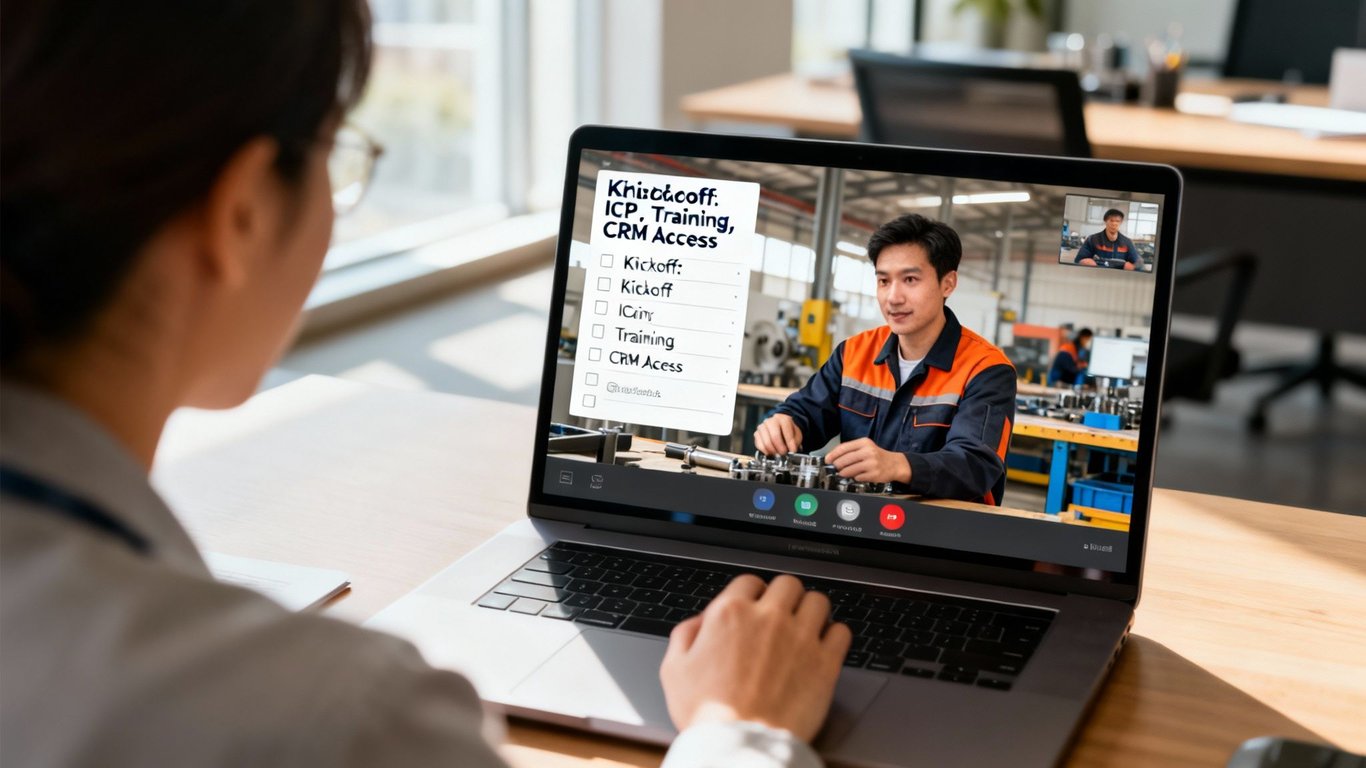
You have vetted candidates and selected a promising appointment setter. However, even a seasoned professional will struggle without a proper onboarding process. The first week is critical; it sets the tone for the entire relationship.
The goal is to move beyond simply providing a contact list and a script. A well-designed onboarding process integrates a contractor into your sales team, ensuring they understand your business, buyers, and objectives. Investing this time upfront is the most effective way to achieve rapid pipeline growth.
Your Essential Onboarding Checklist
A disorganized onboarding process leads to confusion, brand misrepresentation, and poor results. To avoid this, your first few days should be structured around a clear checklist that provides your new setter with everything they need to book quality meetings.
Here’s what that initial deep dive should cover:
- Product Boot Camp: They do not need to be an engineer, but they must understand your core value proposition. Provide essential materials: product one-pagers, impactful case studies, and a link to a recorded demo.
- Ideal Customer Profile (ICP) Workshop: Go beyond company size and industry. Discuss the specific challenges your ideal customer faces. What events trigger their need for a solution like yours? What are the real-world outcomes they achieve after purchasing?
- Tech and Tools Access: Grant access on day one. Create their account in the CRM, add them to your sales engagement platform (like Outreach or Salesloft), and provide access to shared folders with sales collateral.
- Strategy Kickoff Call: This is a strategic planning session, not just a welcome meeting. Align on goals, KPIs, messaging, and communication frequency. It should be a two-way conversation where you share your vision and they contribute their front-line expertise.
A well-run onboarding is about building alignment, not just transferring information. When your outsourced setter feels like part of the team, they represent your brand with more confidence and conviction. Prospects can sense that authenticity, which leads to better conversations.
Done right, the impact can be fast and significant. B2B companies that outsource appointment setters often achieve faster pipeline growth than those relying solely on in-house teams. You can learn more about how specialized reps accelerate revenue by allowing your closers to focus on closing, not prospecting.
Building the Outreach Playbook Together
A common mistake is providing a rigid, pre-written script and expecting immediate success. Top-tier appointment setters are not script readers; they are conversational experts. The most effective approach is to build the outreach playbook with them.
Use your kickoff call to collaboratively map out the initial outreach sequences. Your input is vital for brand voice and product accuracy. Their input is equally crucial for ensuring the messaging sounds human and generates responses. For those who have worked with commission-only sales reps, this type of collaboration is standard practice.
A Simple Multi-Touch Email Sequence to Start
Think in terms of a logical flow rather than isolated emails. Here is a simple framework for manufacturing that you can develop with your setter.
- Email 1 (The Pain Point): Address a problem relevant to their role. For example: "Reducing unplanned downtime on your CNC machines." Briefly position your solution as the answer.
- Email 2 (The Proof): A few days later, follow up with a concise case study or a quote from a similar company. For instance: "A leading automotive supplier in Ohio cut their maintenance costs by 18% using our predictive platform."
- Email 3 (The Soft Ask): Reference the first two emails and offer a clear, low-friction next step. Replace "Can I have 15 minutes?" with something like, "Worth a brief chat next week to see if we could do the same for you?"
A Cold Call Opener That Actually Works
You have about ten seconds to earn the right to continue a cold call. Your opener must be direct, confident, and focused on the prospect.
Scenario: Calling a Plant Manager at an automotive parts manufacturer.
"Hi [Prospect Name], it's [Your Name] from [Your Company]. I know I'm calling unexpectedly, so I’ll be brief. We recently helped another parts manufacturer in the Midwest reduce their assembly line changeover time by over 20%. I was calling to understand how you're handling production scheduling to determine if a conversation about our approach would be relevant."
This opener is effective because it immediately establishes relevance, provides social proof, and frames the conversation around their business needs, not your product features. By building these foundational plays together, you are setting your outsourced setter up for success from day one.
Measuring Performance with the Right KPIs

To effectively manage the appointment setters you outsource, you must look beyond surface-level numbers. It is easy to focus on vanity metrics—such as call volume or emails sent—but these activities alone do not generate revenue. The true measure of success lies in the outcomes that grow your sales pipeline.
Shifting focus from tracking activity to measuring results is what distinguishes a profitable partnership from a frustrating experiment. This requires focusing on a handful of key performance indicators (KPIs) that reveal the health of your top-of-funnel efforts.
Core KPIs That Actually Matter
When establishing your reporting structure, insist on tracking metrics that reflect both efficiency and quality. A calendar full of booked meetings is useless if attendees do not show up or if they are not the right audience for your sales team.
These are the essential KPIs to build your dashboard around:
-
Conversation-to-Appointment Ratio: This metric shows how many meaningful conversations are required to book one meeting. It is a direct measure of the setter's ability to communicate your value proposition and secure a commitment.
-
Appointment Show-Up Rate: This is a simple but critical metric: what percentage of booked appointments actually take place? A rate below 80% is a significant red flag. It could indicate poor prospect qualification, a weak confirmation process, or targeting individuals who were never genuinely interested.
-
Appointment-to-Qualified-Opportunity Rate: This is the ultimate performance indicator. Of the meetings that occur, how many does your sales team accept as a legitimate, qualified sales opportunity? This KPI confirms that your setter understands your ideal customer and is not just booking meetings to meet a quota.
Your goal isn't just meetings; it's meetings that move the needle. A setter who books five highly qualified appointments that convert to real opportunities is infinitely more valuable than one who books twenty that go nowhere.
Building a Simple Weekly Reporting Dashboard
You do not need complex software for this. A simple shared spreadsheet or a basic dashboard in your CRM is sufficient to monitor progress and identify trends early. A quick weekly check-in centered around this dashboard keeps everyone aligned.
Here is a practical, no-fluff structure for a weekly report:
| Metric | Last Week | This Week | Goal | Notes |
|---|---|---|---|---|
| Dials / Emails Sent | 450 | 475 | 500 | Activity is consistent. |
| Meaningful Conversations | 25 | 28 | 30 | Quality conversations are up. |
| Appointments Set | 7 | 6 | 8 | Slightly below target. |
| Show-Up Rate | 86% | 100% | >80% | Excellent confirmation process. |
| Qualified Opportunities | 4 | 5 | 5 | Hit the quality goal. |
This type of snapshot provides a comprehensive view. For example, if Appointments Set is down but Qualified Opportunities is up, that is positive news. It indicates your setter is prioritizing quality over quantity.
The Power of Regular Feedback Sessions
Data is only one part of the equation. Your dashboard shows what is happening, but a conversation reveals why. Schedule a consistent 30-minute call each week to review the numbers and, more importantly, to hear what your setter is learning from their conversations on the front lines.
These sessions are an opportunity to fine-tune your strategy together. If they consistently encounter the same objection, brainstorm a better response. If a specific email subject line has a high open rate, determine how to leverage it further.
This collaborative approach transforms a client-contractor relationship into a genuine strategic partnership. High-growth companies report that professional outbound agencies can accelerate pipeline growth. With the global outsourcing market projected to grow significantly, learning how to find and nurture this kind of talent is a massive competitive advantage. You can explore 2025 outsourcing stats to understand the scale of this opportunity. By investing in this partnership, you are not just managing a task; you are building a powerful engine for your entire sales pipeline.
Dodging Costly Mistakes and Legal Blind Spots
A successful partnership with an outsourced appointment setter requires more than a handshake. It must be built on a solid legal foundation and an awareness of common pitfalls that can undermine your efforts. Overlooking these details can lead to missed targets, brand damage, and wasted resources.
Your best defense is a comprehensive, written agreement. This is not a formality; it is your operational playbook. It must be clear, leaving no room for interpretation regarding the scope of work, compensation, and performance expectations.
Must-Haves in Your Contract
Your agreement is the most important tool for managing this relationship and protecting your company. While you should have it reviewed by a legal professional, ensure these key points are covered to avoid future complications:
- Confidentiality and Data Ownership: Your prospect lists and sales playbook are valuable intellectual property. The contract must explicitly state that any data you provide, and any data the setter generates on your behalf, remains 100% your property. A robust non-disclosure agreement (NDA) is essential.
- Airtight Definition of a "Qualified Appointment": This is a common point of failure. You must define exactly what constitutes a successful outcome. Does it require a specific job title? A company of a certain size? Is the final decision-maker required to attend? Nailing down these criteria prevents disputes over unqualified appointments.
- The "Escape Hatch" (Termination Clause): Not all partnerships work out. Your agreement needs a clear exit strategy. Specify the terms for ending the contract, whether for poor performance, a breach of terms, or a simple no-fault notice period.
Managing the Day-to-Day Relationship Hurdles
Beyond the legal framework, certain operational issues can quickly damage a good partnership. Proactively addressing these is key to achieving a positive return on your investment.
The most common problem is poor communication. Your outsourced setter is the voice of your brand to potential customers. If you fail to inform them of product updates or shifts in sales strategy, they are operating without necessary information and cannot perform their job effectively.
A setter who feels like a disconnected freelancer will perform like one. But a setter who feels like a strategic partner—kept in the loop and supported—will become a genuine growth engine for your business.
Neglecting ongoing support is a recipe for failure. Schedule regular check-ins. These are not just for monitoring metrics; they are an opportunity to review what is working, share feedback from the front lines, and collaboratively refine the outreach strategy. This feedback loop is what transforms a simple contractor into a true extension of your team.
Your Top Questions, Answered
Here are answers to some of the most common questions from manufacturing leaders considering outsourcing their appointment setting.
How Quickly Can I Expect to See Real Results?
While every situation differs, a realistic timeline is seeing the first qualified appointments on your calendar within 30 to 60 days.
The first one to two months should be considered a ramp-up period. During this time, your new partner is building lists, refining messaging, and learning the nuances of your ideal customer. You should expect a consistent, predictable flow of meetings to begin developing around the 90-day mark as the outreach strategy matures.
What’s the Real Difference Between an Appointment Setter and an SDR?
An appointment setter has one primary responsibility: booking a qualified meeting with one of your sales executives. It is a highly focused role.
A Sales Development Representative (SDR) typically has a broader scope. They may conduct more in-depth prospecting, handle initial qualification calls, and nurture leads before the handoff. In the context of outsourcing, however, the terms are often used interchangeably.
The bottom line is this: both roles are designed to solve the same problem. They handle the top-of-funnel grind so your experienced closers can spend their time in qualified meetings, not chasing them.
What Should I Budget for This?
The cost depends on the engagement model you choose. Each has its own financial structure.
- Pay-per-appointment: This model is purely performance-based. You can expect to pay anywhere from $550 to $1,700 for each qualified meeting that occurs.
- Monthly Retainers: If you partner with an agency, you are often looking at a monthly retainer between $3,000 and $8,000. This typically includes a dedicated team and a more comprehensive service.
- Commission-Only: In this model, there is zero upfront cost. Instead, you pay a percentage of the deal value if it closes. This creates powerful alignment, as the reps are only compensated when you generate revenue.
Finding the right independent reps shouldn't be a gamble. On Zilla Sales, you connect with verified, commission-only manufacturing reps who already have the buyer relationships you need. Post your opportunity for free and start seeing matches in 48 hours. Fix your empty territories today.
Keep Reading
More insights for high-performance sales teams.

A Modern Guide to B2B Door to Door Companies
Uncover how modern door to door companies work, the real costs, and the risks. Learn about a smarter alternative for fast B2B territory growth.

Mastering Software Sales Training for Elite Reps
Build a world-class software sales training program. This guide details the curriculum, metrics, and tools needed to accelerate revenue with your sales team.

How Does Commission Work in Sales? A Manufacturer’s Guide
Understand how does commission work in sales. This guide explains common structures, calculation examples, and best practices for B2B manufacturing companies.
Ready to find your sales partner?
Join manufacturers who are successfully expanding their territories with our network. Post a listing in minutes and start receiving matches.
✓ Verified Professionals • ✓ No Long-term Contracts