


B2B marketing for manufacturing is the entire process of promoting industrial products and services directly to other businesses. It's a strategic discipline focused on building long-term relationships with highly technical buyers. The traditional playbook of cold calls and trade show handshakes is no longer sufficient. Today, success requires providing value through deep technical content and a commanding digital presence.
Understanding the Modern Manufacturing Buyer
The landscape for manufacturing marketers has fundamentally changed. Relying solely on a sales team to find and close deals is an outdated model. Today's industrial buyers—whether they are design engineers, plant managers, or procurement specialists—are expert researchers. They conduct the majority of their research online long before contacting a sales representative.

This is a permanent shift in how industrial parts, equipment, and machinery are discovered and purchased. The modern buyer’s journey is now digital-first, driven by a need for technical specifications, performance data, CAD models, and clear evidence that a product will perform as promised.
Data from Gartner shows that B2B buyers spend only 17% of their time meeting with potential suppliers when they are considering a purchase. This means your website, technical datasheets, and online reputation are doing the initial selling.
To understand the magnitude of this change, compare the traditional approach with the modern one.
Shift in Manufacturing Buyer Behavior
| Attribute | Traditional Buyer (Then) | Modern Buyer (Now) |
|---|---|---|
| Information Source | Sales reps, trade shows, print catalogs | Search engines, supplier websites, peer reviews |
| First Contact | Initiated by a sales call or event visit | Initiated by the buyer after extensive online research |
| Content Needs | Brochures, sales presentations | CAD files, technical specs, case studies, videos |
| Pace of Journey | Linear and guided by sales | Self-directed and non-linear |
| Decision-Making | Relied heavily on relationships | Driven by data and peer validation |
| Vendor Expectation | Provide a solution | Be a technical resource and partner |
This comparison makes it clear: if you are not providing the technical, data-rich resources buyers need online, you are not a contender.
Who Are You Selling To?
To succeed, you must understand the key players. Manufacturing purchasing decisions are almost always made by a committee, and each member has a distinct role. Your marketing must address the needs of all of them.
-
Engineers and Technical Specialists: These are your primary influencers. They require data. Provide them with detailed spec sheets, downloadable CAD files, performance charts, and real-world application notes. Their goal is to validate that your product solves their technical problem with precision.
-
Procurement Managers: These individuals focus on financial metrics. They analyze price, lead times, supply chain stability, and the total cost of ownership. Content that clearly articulates ROI and long-term value will capture their attention.
-
C-Suite Executives and Decision-Makers: This group is concerned with strategic impact. They need to understand how your solution enhances operational efficiency, reduces risk, or provides a competitive advantage. High-level case studies and reports demonstrating clear business impact are essential for this audience.
The primary challenge in B2B marketing for manufacturing today is not just finding customers. It is about equipping multiple stakeholders with the right technical and business information they need, precisely when they seek it during their independent research.
Failing to meet these digital demands renders your business invisible to a large portion of your market. This guide provides a practical playbook for building a marketing system that attracts modern buyers. By understanding these dynamics, you can explore ZILLA's insights on marketing strategies for the industrial manufacturing sector and position your brand for significant growth.
Building Your Digital Marketing Foundation
Once you understand your buyer's digital-first mindset, the next step is to meet them where they spend their time online. A solid B2B marketing strategy for any manufacturer depends on a strong digital foundation. This is not about chasing fleeting trends; it’s about mastering the core channels that consistently deliver tangible results for industrial companies.

Consider your website your primary sales tool and digital headquarters. It must be more than a static online brochure; it must function as a dynamic, high-performance technical resource center. Given that a significant number of B2B buyers use mobile devices during their research process, your site must be fully responsive and perform flawlessly on any screen.
This foundation rests on three core pillars: Search Engine Optimization (SEO), Content Marketing, and Email Marketing. Each plays a distinct role in guiding a prospect from initial awareness to becoming a sales-ready lead.
Master SEO for Technical Discovery
At its core, Search Engine Optimization is about ensuring your company appears when engineers and procurement managers search for the solutions you provide. For manufacturers, effective SEO is not about ranking for generic keywords. It is about capturing high-intent, technical search queries. Your buyers are not searching for "CNC machines"; they are searching for terms like "5-axis CNC machining for titanium aerospace components."
The objective is to be the top result for these highly specific, problem-solving phrases. To achieve this, implement a focused approach.
- Conduct Technical Keyword Research: Use SEO tools to identify the exact phrases, part numbers, and technical specifications your audience is searching for. Include material types, industry standards (e.g., ISO, ANSI), and specific application challenges.
- Optimize Product and Service Pages: Treat each page as a comprehensive resource. Include detailed specifications, application notes, performance data, and ensure titles and meta descriptions use your target keywords.
- Maintain Technical Site Health: A fast, secure, and mobile-friendly website is non-negotiable. Slow-loading pages will cause potential customers to leave before they see your offerings.
Create Content That Builds Trust
Content marketing is the engine that powers your digital strategy. It is how you demonstrate expertise and build the trust required to secure high-value contracts. Industrial buyers require substance, so your content must focus on educating and solving real-world problems.
Your content should not be an interruption to your prospect's day; it should be the reason they engage with your brand. It must provide genuine value by answering their most pressing technical and business questions.
Focus on creating assets that directly support their research and decision-making process. This is your opportunity to provide the proof behind your product claims.
Types of High-Impact Manufacturing Content
| Content Type | Primary Goal | Target Audience |
|---|---|---|
| Case Studies | Provide social proof and demonstrate real-world success | Procurement & C-Suite |
| Whitepapers | Explore complex industry problems and present your solution | Engineers & Technical Leads |
| CAD Drawings | Allow engineers to easily integrate your components into their designs | Design Engineers |
| Spec Sheets | Deliver critical performance and material data in a clear format | All Technical Buyers |
| Explainer Videos | Show complex products or processes in action for easy understanding | All Audiences |
Each piece of content you create should be a tool that moves a prospect forward, answering their questions and building their confidence in your capabilities.
Nurture Leads with Strategic Email Marketing
The sales cycle in manufacturing is often long, stretching over months or even years. Email marketing is your most effective tool for staying top-of-mind and nurturing relationships throughout this extended timeline. It allows you to deliver the right content to the right person at the right time.
Effective email marketing relies on segmentation. Do not send the same generic message to all contacts. Group your contacts by industry, job role, or the specific product they have shown interest in. An engineer who downloaded a whitepaper on aerospace materials requires a different follow-up than a procurement manager who requested a quote for a standard part.
Use marketing automation to build nurturing sequences. For example, a new lead could receive a welcome series introducing your company, followed by a case study relevant to their industry, and then an invitation to a technical webinar. This automated, value-driven approach builds a relationship without over-burdening your sales team. When the buyer is ready to talk, your company will be their first consideration.
Getting in Front of Your Biggest Opportunities with ABM and Events
A strong digital presence is effective for casting a wide net and generating a steady stream of inquiries. However, in manufacturing, some accounts are too important to leave to chance. They require a direct, focused approach. This is where strategies like industry events and Account-Based Marketing (ABM) become mission-critical.
Think of it this way: broad digital marketing is like fishing with a net. ABM and events are like spear fishing—you identify your most valuable targets and pursue them with precision.

These high-touch methods are a strategic investment designed to shorten long sales cycles and forge relationships with key decision-makers. When you combine the scale of digital marketing with the focus of targeted outreach, you create a powerful engine for both generating leads and closing major accounts.
Getting Real ROI from Trade Shows and Industry Events
For manufacturers, trade shows remain highly relevant. They are often the only venue where you can engage with engineers, procurement managers, and executives in the same place. They provide an opportunity to demonstrate complex machinery, have in-depth technical conversations, and build trust face-to-face.
However, simply showing up with a well-designed booth is not enough. Success depends on a strategy executed before, during, and after the event.
The real work begins long before the doors open.
- Pre-Show Planning: Obtain the attendee list and identify key contacts you want to meet. Use targeted emails and LinkedIn messages to schedule meetings in advance. Inform them of your presence and highlight specific solutions relevant to their challenges.
- On the Floor: Train your booth staff to quickly qualify visitors, understand their technical needs, and connect them with the right expert on your team. Time is your most valuable asset on the show floor, so use it efficiently.
- Post-Show Follow-Up: This is a critical step where many companies fail. Implement a process to follow up with every qualified lead within 24-48 hours. Avoid generic "thanks for stopping by" emails. Personalize your communication based on your conversation and deliver any promised information promptly.
Adopting an Account-Based Marketing (ABM) Mindset
Account-Based Marketing inverts the traditional marketing funnel. Instead of casting a wide net to generate numerous leads, ABM concentrates all marketing and sales efforts on a curated list of high-value accounts. The focus is on quality over quantity.
With ABM, you treat each target company as its own market. The goal is not just to generate one lead from a company; it is to engage the entire buying committee with a coordinated and highly relevant message.
This strategy requires tight alignment between your sales and marketing teams, from selecting the target list to executing every touchpoint.
Key Steps to Launch an ABM Initiative
- Identify Your Target Accounts: Collaborate with sales to build a list of "ideal clients." These are companies that fit your ideal customer profile and have the potential for significant long-term revenue.
- Map Out the Account: For each target, conduct thorough research. Identify the key players in the buying committee—the engineer, the plant manager, the finance person, the executive. Understand their specific challenges, strategic goals, and who influences the final decision.
- Create Personalized Plays: Develop content and messaging that speaks directly to their needs. This could be a custom report analyzing their production line, a webinar focused on their industry's biggest challenge, or targeted digital ads.
- Execute Coordinated Outreach: Launch a multi-channel campaign where sales and marketing are perfectly synchronized. A salesperson’s introductory email might arrive on the same day the engineering team at the target company begins seeing a relevant LinkedIn ad from you.
- Measure What Matters: Track metrics that lead to revenue: engagement across the buying committee, meetings booked, and the velocity of accounts moving through the sales pipeline.
Equipping Your Sales Channels for Success
Even the most effective marketing engine will fail if the handoff to sales is poorly managed. In manufacturing, your marketing is only as good as your sales channels’ ability to convert interest into purchase orders. This is especially true when working with a network of independent manufacturer's reps, who are often your primary connection to the customer.
Sales channel enablement is the critical bridge connecting marketing leads to closed deals. It is the process of equipping your internal team and external reps with the content, tools, and training they need to win. Without it, the effort you put into generating high-quality leads gets lost in the field.
This is an ongoing strategy to ensure every person selling your product is confident, knowledgeable, and prepared for conversations with technical buyers.
Arming Reps with Assets They Will Actually Use
Sales reps, particularly independent ones, manage multiple product lines and have limited time. They will not spend an hour searching a disorganized shared drive or reading a lengthy technical manual. The materials you provide must be concise, easy to find, and immediately useful in a sales context.
The goal is to answer a prospect's question before the rep even has to ask you, which builds their confidence and shortens the sales cycle.
- Product One-Pagers: These are essential sales tools. A single page should cover key features, essential tech specs, common applications, and target industries. It must be scannable and easy for a rep to attach to a follow-up email.
- Competitive Battle Cards: Your reps compete with other companies daily. Battle cards provide a quick rundown of how your product compares, highlighting key differentiators and offering proven responses to common objections.
- Vertical-Specific Case Studies: A success story in the aerospace industry will not resonate with a medical device engineer. Create tailored case studies that demonstrate your value in the specific markets your reps serve.
To prioritize content creation, ask: "Will this piece of content help a rep close a deal today?" If the answer is not a clear "yes," it is likely not a priority.
Providing these targeted resources transforms your sales channel from order-takers into consultative partners who drive growth.
Bridging the Gap with the Right Talent
A significant challenge in manufacturing is not just equipping existing reps, but also finding the right ones to begin with—especially when expanding into new territories. Traditional recruiting is slow, expensive, and a poor hire can set back your growth plans by months.
Specialized platforms can change this dynamic. They connect manufacturers with a pool of pre-vetted, experienced independent reps seeking new product lines. This model allows you to bypass the long hiring cycle and get your product in front of established buyers quickly.
For example, many manufacturers use platforms like Zilla Sales to find commission-only sales reps who already have deep relationships in the exact industries and territories you want to penetrate. This approach reduces risk and upfront investment, as you only pay for performance. It is an efficient way to fill empty territories and test new markets without the overhead of hiring a direct sales team.
Creating a System for Success
You have built a library of excellent content. Now, you must ensure your reps can find it when they need it. They require a single, easy-to-use portal to access the latest version of any sales tool. This is non-negotiable for maintaining brand message consistency.
Your enablement system should include these key elements:
- A Central Content Hub: A cloud-based platform where all collateral is organized by product line, industry, and content type. This eliminates the need to search through old emails.
- Regular Training Sessions: Host short, quarterly webinars to roll out new products, share competitive updates, and highlight recent sales wins to demonstrate what is working.
- An Open Feedback Loop: Provide a simple way for reps to request new content or give feedback on what is effective in the field. This direct market intelligence is invaluable for refining your messaging and strategy.
Executing a 90-Day Territory Activation Plan
Entering a new sales territory or revitalizing a dormant one requires a fast, focused strategy. For manufacturers, a strong independent rep is invaluable, but they need a playbook that enables immediate action. A well-designed 90-day activation plan provides this roadmap, turning potential into sales opportunities from day one.
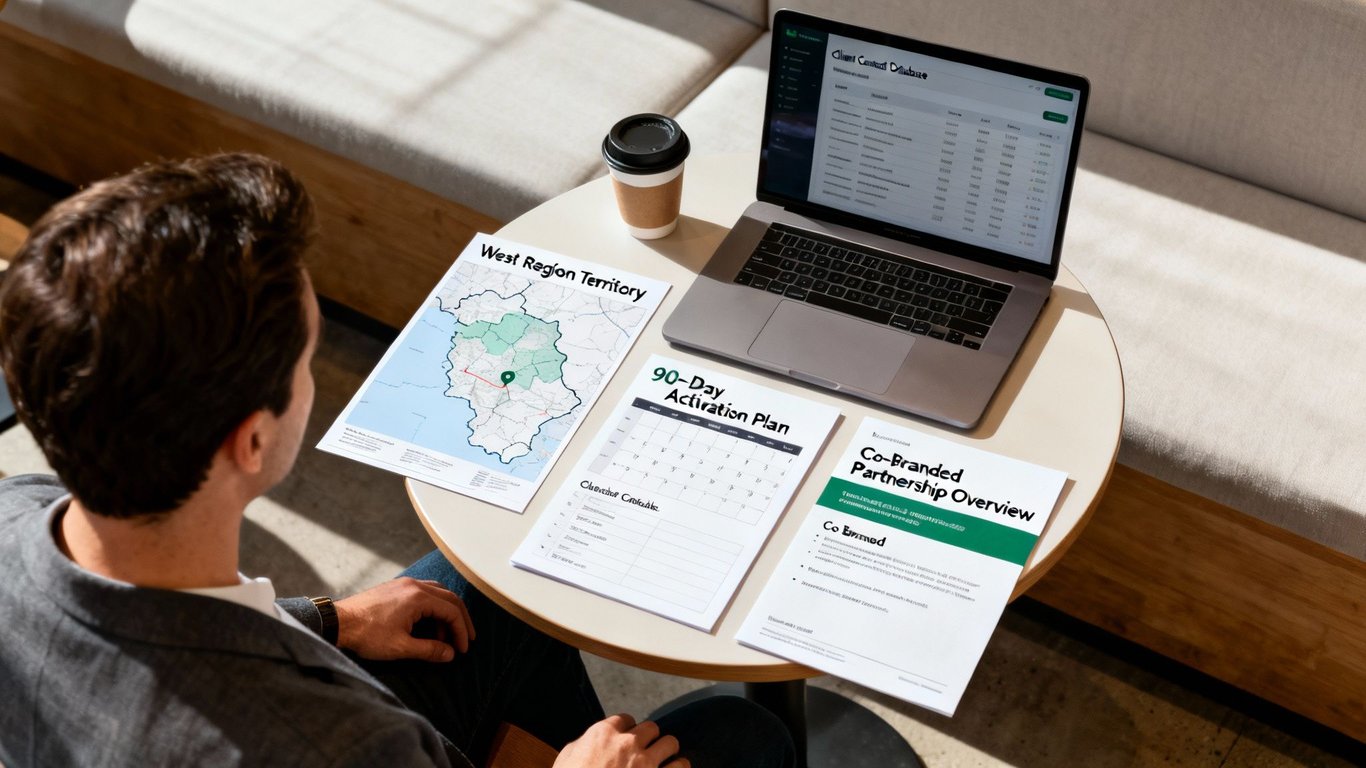
This is not about random cold calling. It is a strategic sequence designed to leverage a rep's existing network and amplify it with your marketing support. The objective is to secure the first qualified leads and meetings as quickly as possible to prove the partnership's value and build momentum.
The framework below divides the first quarter into three distinct phases, each with a clear focus, moving from preparation to broader outreach and pipeline building.
The First 30 Days: Foundation and Quick Wins
Month one focuses on mastering the basics and leveraging the warmest contacts. A seasoned rep has a book of business built over years. The first priority is to introduce your product line to that trusted network.
In this phase, the rep must deeply understand the product's value proposition using the sales enablement materials you provide. Concurrently, they must identify the top 15-20 contacts in their existing network who are an ideal fit for your products.
Key actions for this period include:
- Co-branding initial outreach emails: Provide a simple, customizable email template for the rep to send to their warmest contacts.
- Scheduling "friendly" introductory calls: Conduct low-pressure conversations with existing customers to introduce the new line and gather feedback.
- Mapping the territory: The rep should identify and segment the top 50 target accounts in the region by industry and potential fit.
The Next 30 Days: Expanding the Reach
With early feedback gathered and a target list established, the second month shifts from the rep’s inner circle to a more structured attack on the wider territory. This is where a coordinated B2B marketing for manufacturing push between your company and the rep becomes critical.
The goal is to systematically target the top 50 accounts identified in month one. The rep will execute a multi-touch outreach sequence, using personalized emails, phone calls, and LinkedIn connections. Your marketing team should support these efforts with targeted campaigns to warm up these accounts before the rep makes contact.
A new rep's success depends on their ability to quickly leverage trust. The 90-day plan is designed to methodically expand that circle of trust from known contacts to new prospects, backed by the manufacturer's credibility.
Success in this phase is measured by the number of meaningful conversations and product demos scheduled with key decision-makers at target companies.
The Final 30 Days: Building the Pipeline
In the last month, the focus shifts from pure outreach to pipeline development. By now, the rep should have several active conversations. The priority is to nurture these developing deals while maintaining a steady cadence of outreach to the rest of the target list.
This is also the time to analyze what is working. The rep and the manufacturer should review initial results together to identify which messages and industries are showing the most promise. This early data is critical for refining the go-to-market strategy. By day 90, the partnership should have a clear market view, a small but growing pipeline, and a data-driven plan for the next quarter.
90-Day Territory Activation Playbook
This playbook summarizes the key actions and goals for a new representative in their first three months, ensuring alignment and focus at each stage.
| Phase (Days) | Key Focus | Primary Activities | Success Metric |
|---|---|---|---|
| 1-30 | Foundation & Quick Wins | Internalize value prop, identify top 15-20 warm contacts, map top 50 accounts. | Initial meetings with existing network. |
| 31-60 | Expanding the Reach | Execute multi-touch outreach to top 50 targets, coordinate with manufacturer's marketing. | 3-5 qualified meetings with new prospects. |
| 61-90 | Building the Pipeline | Nurture active opportunities, continue outreach, analyze early data to refine the strategy. | 1-2 opportunities entered into the pipeline. |
This 90-day plan ensures a structured, momentum-building start that turns a new partnership into a revenue-generating machine.
Measuring the KPIs That Actually Drive Revenue
In manufacturing, production lines are not run on guesswork, and the same principle applies to marketing. To determine if your marketing efforts are effective, you must look beyond vanity metrics like website traffic or social media followers. It is essential to focus on Key Performance Indicators (KPIs) that tie directly to revenue.
This is how you demonstrate marketing's value, justify your budget, and make smarter decisions. By tracking the right numbers, you can show exactly how marketing is filling the sales pipeline and helping reps close deals faster.
Focus on What Puts Money in the Bank
The most important metrics track a lead's journey from their first interaction to a signed contract. This requires alignment between marketing and sales on the definition of a "qualified lead"—a critical step that many companies overlook.
Here are the core KPIs that should be on your dashboard:
- Marketing Qualified Leads (MQLs): An MQL is a person who has shown genuine interest by taking a specific action, such as downloading a detailed whitepaper or requesting a demo. This is a much stronger signal than a simple newsletter signup.
- Sales Qualified Leads (SQLs): An MQL becomes an SQL after a sales rep has spoken with them and confirmed they have a real problem you can solve, the budget to address it, and the authority to make a decision. The MQL-to-SQL conversion rate is a key indicator of lead quality.
Tracking the journey from MQL to SQL is like monitoring a manufacturing process. You want a high yield rate, ensuring the raw materials (leads) that marketing provides are high-quality enough to be converted into finished goods (customers) by sales.
Beyond lead volume, you must also measure the efficiency of your marketing spend. The following two KPIs connect your activities directly to the bottom line.
- Customer Acquisition Cost (CAC): This metric tells you exactly how much you spent on marketing and sales to acquire one new customer. A consistently decreasing CAC indicates that your marketing is becoming more efficient.
- Sales Cycle Length: This is the time it takes to close a deal, from the first touchpoint to the signed contract. Effective marketing should shorten this timeline by educating prospects early and building trust, which facilitates a more productive conversation for your sales team or an outsourced sales team.
Frequently Asked Questions
When modernizing a manufacturing company's sales and marketing, questions often arise regarding budget, priorities, and talent. Here are answers to some of the most common challenges manufacturing leaders face.
How Much Should a Manufacturing Company Budget for Marketing?
For established manufacturing companies, a general guideline is to allocate 1-5% of total revenue to marketing. This is not a rigid rule. If you are launching a new product line or entering a new market, a more aggressive investment—closer to 10%—may be necessary to build momentum.
The most important mindset shift is to view marketing as a measurable investment, not just an expense. Tie your budget to specific business goals, such as generating a target number of qualified engineering leads, and track your return on investment rigorously. This data will inform where to increase spending and how to adjust your strategy for optimal results.
What Is the Most Important Marketing Tactic for a Manufacturer?
If you must prioritize one area, focus on building an expertly designed, technically informative website supported by strong SEO. Your website is your digital storefront, your most effective salesperson, and the primary destination for buyers conducting their own research.
Your website must be more than a digital brochure. It needs to be easy to navigate, rich with detailed product specifications and downloads, and feature convincing case studies that demonstrate how you solve real-world problems. Most importantly, it must be simple for a potential customer to contact you. All other marketing activities, from email campaigns to trade shows, should be designed to drive qualified traffic back to your site.
How Can We Find Qualified Independent Sales Reps Quickly?
Finding experienced, industry-savvy independent reps can be a significant bottleneck that stalls expansion plans. Traditional methods like job boards and recruiters are often slow, costly, and unreliable. You can spend months on a search and end up with reps who lack the right industry connections.
A more effective approach is to use a dedicated marketplace built for this purpose. These platforms connect you directly with a pre-vetted network of commission-only reps who already possess the relationships and technical knowledge in your target markets. This model reduces financial risk and dramatically shortens the hiring cycle, allowing you to cover empty territories and generate sales more quickly.
Ready to stop searching and start selling? Zilla Sales connects you with a vetted network of industry-specific independent sales reps who are ready to hit the ground running. Find qualified reps and fill your empty territories fast.
Keep Reading
More insights for high-performance sales teams.

A Modern Guide to B2B Door to Door Companies
Uncover how modern door to door companies work, the real costs, and the risks. Learn about a smarter alternative for fast B2B territory growth.

Mastering Software Sales Training for Elite Reps
Build a world-class software sales training program. This guide details the curriculum, metrics, and tools needed to accelerate revenue with your sales team.

How Does Commission Work in Sales? A Manufacturer’s Guide
Understand how does commission work in sales. This guide explains common structures, calculation examples, and best practices for B2B manufacturing companies.
Ready to find your sales partner?
Join manufacturers who are successfully expanding their territories with our network. Post a listing in minutes and start receiving matches.
✓ Verified Professionals • ✓ No Long-term Contracts